
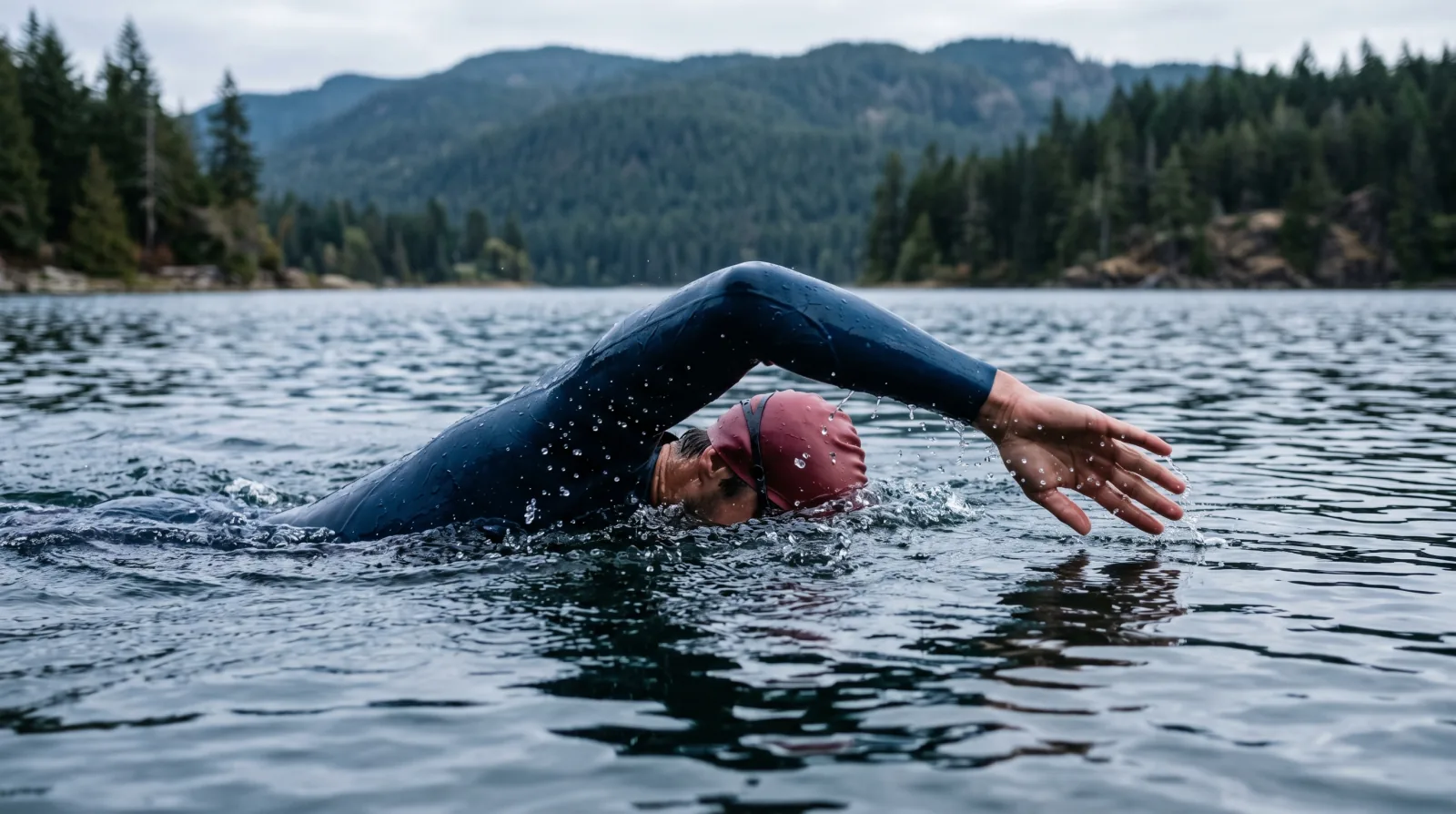
Swimmer's Shoulder: Why Open-Water Season Brings Shoulder Pain, and What Fixes It
Swimmer's shoulder is the overuse injury of the open-water season. It is rarely about one bad stroke and almost always about volume, capacity, and technique together.
BY ALI SHAFIEI, RPT
When the lakes warm up and open-water season arrives on the North Shore, swimmers ramp up their distance, and a predictable wave of shoulder pain follows. Swimmer's shoulder is one of the classic overuse injuries of the season. The mistake most people make is hunting for a single cause, when it is almost always several factors working together.
Swimmer's shoulder is almost always caused by a combination of training volume that outpaced the shoulder's capacity, technique inefficiencies, and strength or mobility gaps rather than a single structural problem. Addressing only one of those factors often gives a partial result. At Medstar Sport Physio in North Vancouver, we look at all three together. The rehabilitation plan typically involves load management, rotator cuff and shoulder-blade strengthening, and stroke review, while keeping the swimmer in the water in a modified form. Complete rest tends to leave the shoulder weaker and the pain returns when swimming resumes. What the right plan looks like depends on how irritable the shoulder is and how long the problem has been building.
What swimmer's shoulder is
Swimmer's shoulder is a general term for the shoulder pain that develops from the high, repetitive load of the freestyle stroke. A competitive or committed swimmer rotates each shoulder through a demanding overhead arc thousands of times per session. That repetition, more than any single movement, is what drives the problem.
It usually involves irritation of the rotator cuff tendons and the surrounding structures from overuse, and it overlaps with the broader category of rotator cuff shoulder pain and shoulder impingement. Crucially, it is an overuse problem rather than a single discrete injury, and that framing shapes everything about how it is treated.
Why it is rarely one thing
People naturally look for the culprit: a bad stroke, a technique flaw, a single session that did the damage. But swimmer's shoulder is typically a combination of factors:
- Training volume that outpaced capacity. The most common trigger is a jump in distance, exactly what happens when swimmers ramp up for the open-water season. The shoulder simply was not conditioned for the sudden increase in load.
- Technique factors. Aspects of the stroke that load the shoulder a little harder than ideal can contribute, especially as fatigue sets in over a long swim.
- Strength and mobility gaps. Weakness in the rotator cuff or shoulder-blade muscles, or restrictions in shoulder movement, can leave the shoulder less able to handle the repetitive load.
Because the problem is multifactorial, addressing only one piece, fixing the technique while ignoring the volume spike, or doing some cuff exercises while never touching the stroke, tends to give partial results. Effective treatment looks at all the contributing factors.
Why rest alone disappoints
The instinct to simply stop swimming until the shoulder feels better rarely solves it. Complete rest settles the pain temporarily but leaves the shoulder deconditioned, so when the swimmer returns to the water the pain comes back, because nothing addressed the volume, technique, or strength factors that caused it.
This is the same pattern we see across overuse injuries. As with cycling knee pain and bike fit, removing the activity without changing the underlying drivers means the problem is waiting when you return. The better path keeps you swimming in a modified form while the real factors are addressed.
What actually works
A good plan for swimmer's shoulder usually combines:
Load management. Reducing swim volume and intensity to a level that does not provoke significant symptoms, rather than stopping entirely, then building back gradually as the shoulder tolerates more.
Strengthening. Targeted work for the rotator cuff and shoulder-blade muscles builds the capacity the shoulder needs to handle the repetitive overhead load. This is often the missing piece, and it is the part that makes the improvement last.
Technique and training review. Looking at the stroke and the training structure to find factors that load the shoulder unnecessarily, and adjusting the build-up so volume increases at a rate the shoulder can adapt to.
The combination is what settles the shoulder, because it addresses the actual web of causes rather than any single thread.
Preventing the next season's flare
The most useful preventive lesson is about sequence: build the shoulder's capacity before building distance, not after. Many swimmers develop problems precisely because they increase volume first and hope the shoulder keeps up. Progressing distance gradually, maintaining rotator cuff and shoulder-blade strength through the off-season, and attending to technique all reduce the risk.
This is the same principle that protects against shin splints in runners: the tissue can handle a great deal of load, but it needs that load to climb at a rate it can adapt to. A shoulder built up over weeks tolerates open-water season far better than one thrown into it.
A realistic timeline
How long swimmer's shoulder takes to settle depends on how irritable it is and how long it has been there. Many cases improve over several weeks with load management, strengthening, and technique work, while more stubborn cases take longer. The most common reason it recurs is returning to full volume too quickly, before the shoulder has rebuilt the capacity to handle it, so the build-back is staged and paced to how the shoulder responds.
When to get it assessed
If your shoulder aches with swimming, especially after ramping up your distance, an assessment identifies the mix of volume, technique, and strength factors driving it and builds a plan that keeps you swimming while it settles. Shoulder pain with significant weakness, instability, or pain that does not fit an overuse pattern is worth assessing to rule out other causes.
Book a 30-minute appointment and we will assess your shoulder, review your training and stroke, and build a plan that gets you back to comfortable open-water kilometres.
This article is general information about swimmer's shoulder. It is not personal medical advice. A regulated practitioner can confirm whether the patterns described apply to you.
Sources
- Hibberd & Myers: Practice habits and attitudes and behaviors concerning shoulder pain in high school competitive club swimmers, Clinical Journal of Sport Medicine (2013)
- Cools et al., Prevention of shoulder injuries in overhead athletes: a science-based approach, Brazilian Journal of Physical Therapy (2015)
- College of Physical Therapists of BC (CPTBC)
Common questions
Frequently asked questions.
What is swimmer's shoulder?
Swimmer's shoulder is a general term for the shoulder pain swimmers develop from the high repetitive load of the freestyle stroke. It usually involves irritation of the rotator cuff tendons and surrounding structures from overuse, often combined with technique and training factors. It is an overuse problem rather than a single injury, which shapes how it is treated.
Should I stop swimming if my shoulder hurts?+
Usually you can keep swimming in a modified form rather than stopping entirely. We reduce volume and intensity to a tolerable level, address technique and any strength gaps, and build back gradually. Complete rest tends to leave the shoulder deconditioned, so the pain often returns when you resume. Managing the load while rebuilding capacity works better than stopping cold.
Is swimmer's shoulder caused by bad technique?+
Technique can contribute, but it is rarely the whole story. Swimmer's shoulder is usually a combination of training volume that outpaced the shoulder's capacity, technique factors, and sometimes strength or mobility gaps. Addressing only technique while ignoring the volume spike or the strength gap tends to give partial results. We look at all the contributing factors.
How do I prevent swimmer's shoulder?+
Progressing training volume gradually, maintaining rotator cuff and shoulder-blade strength, and attending to technique all help reduce the risk. Many swimmers develop problems after a sudden increase in distance, such as ramping up for open-water season. Building capacity before increasing volume, and keeping the shoulder strong, are the most useful preventive steps.
How long does swimmer's shoulder take to settle?+
It varies with how irritable the shoulder is and how long it has been there. Many cases improve over several weeks with load management, strengthening, and technique work, while more stubborn cases take longer. Returning to full volume too quickly is a common reason it recurs, so the build-back is staged rather than rushed.
What happens at a first physiotherapy visit for swimmer's shoulder?+
The physiotherapist asks about your recent training volume, stroke changes, and when the pain started, then tests shoulder movement, rotator cuff and shoulder-blade strength, and how the shoulder responds to overhead loading. The goal is to identify which of the usual factors, volume, technique, or strength, is driving your case, since that mix guides the load management and strengthening plan that follows.
Is swimmer's shoulder the same as rotator cuff tendinopathy?+
They overlap but are not identical. Swimmer's shoulder is a broader term for the shoulder pain that develops from repetitive overhead swimming load, and it usually involves irritation of the rotator cuff tendons and surrounding structures. Rotator cuff tendinopathy can also occur outside of swimming, from other overhead sports or daily activities. The overlap is why swimmer's shoulder rehab draws on the same principles as general rotator cuff rehab.
Can swimmer's shoulder affect other overhead activities, not just swimming?+
Yes. Because swimmer's shoulder usually involves the rotator cuff tendons and shoulder-blade muscles, symptoms can also show up with other overhead tasks such as reaching into a cupboard, throwing, or lifting weights above the head. Addressing the strength and mobility gaps that contribute to swimmer's shoulder often improves tolerance for these other activities too, not only swimming.
Share this post
Copies a ready-to-publish LinkedIn post to your clipboard and opens the LinkedIn share dialog. Paste the text into the composer and publish.

Written by
Ali Shafiei, RPTAli Shafiei is a Registered Physiotherapist with 10+ years of clinical experience in musculoskeletal, neurological and sports rehabilitation. North Vancouver.
This article is for general information only and does not constitute medical advice, diagnosis, or treatment. Individual presentations vary, and assessment findings and treatment plans differ from person to person. If you are experiencing severe symptoms, neurological changes (numbness, weakness, bowel or bladder changes), or a significant trauma, contact your physician or emergency services. Care at Medstar Sport Physio & Health is provided by practitioners registered with their respective British Columbia regulatory colleges.
Filed under
- swimmers-shoulder
- shoulder-pain
- swimming
- rotator-cuff
- north-vancouver


