Hip Labral Tear or FAI? Why the Two Diagnoses Get Used Like Synonyms
A hip report can list both a labral tear and FAI on the same line, and patients often walk away thinking they are two names for one problem. They are not, and the difference changes what a treatment conversation should cover.
BY AMIR AHMADI, PHD
A hip imaging report can list a labral tear and femoroacetabular impingement (FAI) on the same page, and it is easy to walk away thinking they are two names for the same problem. They describe two different things, and knowing which one is actually driving your symptoms changes the conversation.
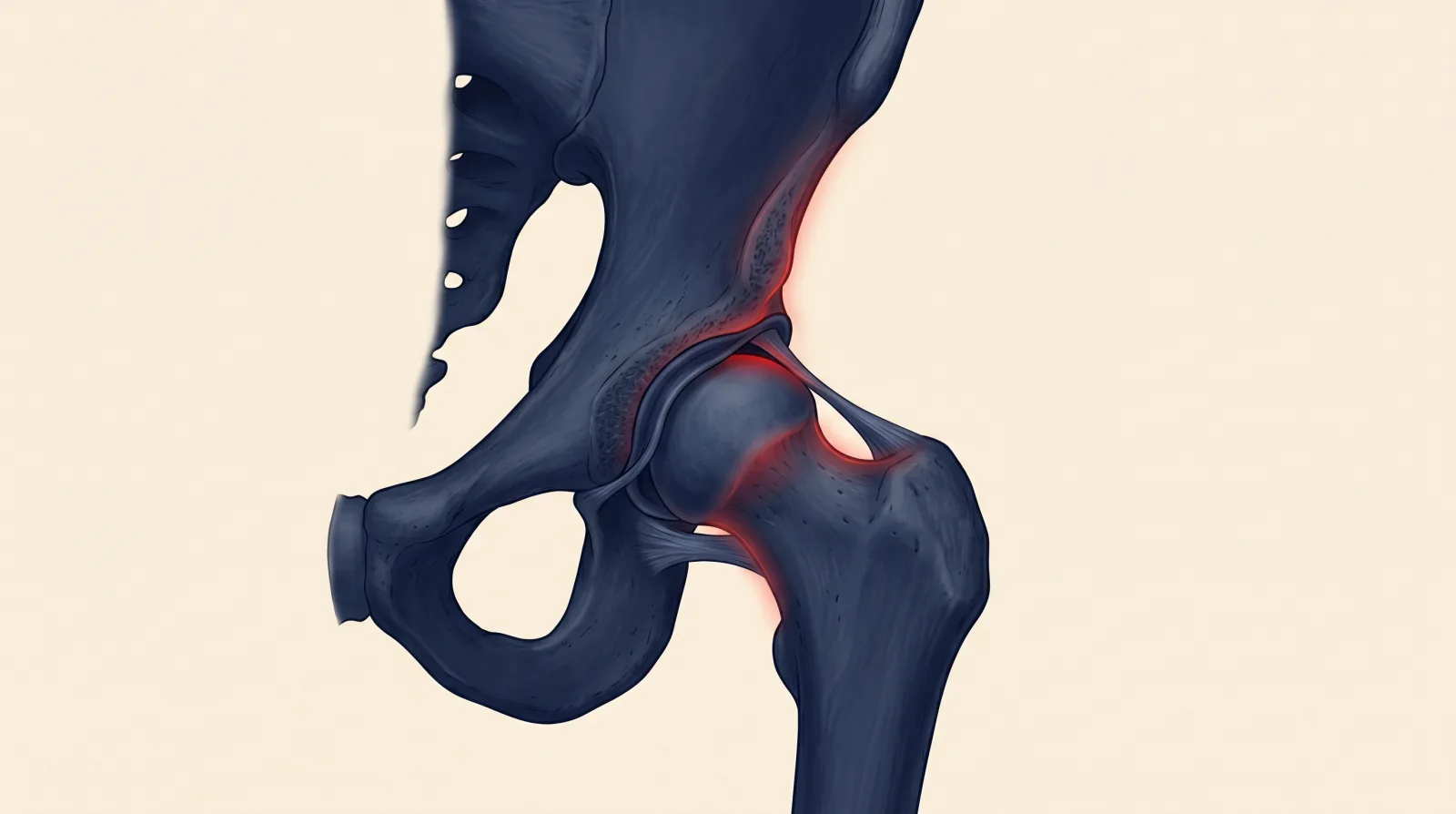
FAI describes the shape of the hip bones causing the ball and socket to pinch in deep positions, while a labral tear is damage to the cartilage rim around the socket that FAI often causes over time. At Medstar Sport Physio in North Vancouver, we treat them as related but separate questions: bone shape alone does not predict pain, a tear alone does not require surgery, and the plan follows whichever finding actually matches your symptoms and exam.
Two different things that get reported together
FAI is a description of bone shape. In cam-type FAI, the ball of the hip joint (the femoral head) has an extra bump of bone where it meets the neck, so it does not glide smoothly in the socket during deep flexion. In pincer-type FAI, the socket itself covers more of the ball than it should, so the rim contacts the neck earlier in the movement. A review of femoroacetabular impingement syndrome reports cam morphology alone in close to half of FAI cases, mixed cam and pincer features in a similar proportion, and pincer alone in a smaller share.
A labral tear is a tissue injury: damage to the ring of cartilage that runs around the rim of the socket. The labrum helps seal the joint and adds some stability. When it tears, that seal and stability are reduced, which is what produces the deep groin pain, catching, or a sense of instability that patients describe.
The two show up together on reports because they are often mechanically connected, not because they are the same finding written twice.
Why FAI and labral tears travel together so often
The same review describing FAI morphology also traces how repeated pinching damages the labrum: as the bone shapes make contact in deep positions over and over, the labrum absorbs that mechanical stress and can develop small tears at the point of contact, most often in the front and outer part of the socket. Over enough repetitions, in a hip already shaped for impingement, that repeated contact is a well-documented pathway to labral damage.
That is the connection that makes FAI and labral tears common report-mates. FAI sets up a mechanical situation, and the labrum is frequently the tissue that ends up carrying the cost of it. This does not mean every FAI hip develops a tear, and it does not mean every labral tear traces back to FAI. It means the two are related often enough that a report naming both is usually describing one connected story rather than two coincidences.
The part that surprises people: neither finding proves you have a problem
Here is where the two diagnoses matter less than people expect. Cam and pincer bone shapes, and labral tears themselves, are documented findings on imaging of hips that have never caused a day of pain. A bone shape consistent with FAI, or a labrum with visible wear, can sit there quietly for years without producing symptoms.
That means an imaging report naming FAI, a labral tear, or both is not by itself a diagnosis of what is wrong with you. It is a structural observation. The diagnosis comes from whether that structural finding actually matches your symptom pattern (deep groin pain with squatting, sitting, or pivoting), reproduces on physical exam tests aimed at the hip joint, and behaves the way FAI or a labral tear typically behaves when loaded and unloaded. Our in-depth post on hip labral tears covers what that tissue-specific pattern looks like and what commonly gets mistaken for it, including gluteal tendon pain on the outer hip rather than the groin.
What changes the treatment conversation
Because bone shape and labral tears are not automatically symptomatic, the decision to pursue conservative care or discuss surgery does not hinge on which term appears on the report. It hinges on three things: how much the finding matches your actual pain pattern, how irritable the hip currently is, and how the joint responds to a structured trial of strengthening and load management.
Our post on managing FAI conservatively walks through what that physiotherapy-first approach looks like for the bone-shape side of this. The approach for a labral tear overlaps heavily: build strength around the hip and pelvis, improve movement control in the positions that provoke symptoms, and manage load in deep hip flexion while that control develops. Whether the underlying report says FAI, labral tear, or both, the early rehabilitation targets are largely the same, because both problems respond to the hip tolerating load better.
When imaging actually changes the plan
Imaging earns its place when it answers a specific question that changes what happens next, not as a routine first step for every case of groin pain. It is useful for ruling out a fracture or another structural issue after a specific traumatic injury, for checking the extent of joint damage before deciding whether a fair trial of rehabilitation makes sense, or for confirming a suspected diagnosis when the clinical picture is genuinely ambiguous.
Imaging ordered before a thorough history and physical exam, or read in isolation without checking it against your actual symptoms, tends to generate more confusion than clarity. A hip with an incidental FAI shape and a small labral tear, found while investigating something unrelated, is a different situation from a hip with the same findings that also reproduces your exact pain on the specific tests aimed at that structure.
What we check at an assessment
When someone comes in with deep groin or front-of-hip pain and a report mentioning FAI, a labral tear, or both, the assessment starts before we look at any imaging. We ask what provoked the pain, whether there was a specific injury or a gradual onset, and which positions flare it. Deep squatting, long car rides, and pivoting on a loaded leg point toward the hip joint itself; pain over the outer hip that is worse lying on that side points somewhere else entirely.
From there we test hip range of motion and specific positions known to stress the labrum or reproduce impingement, and only then look at what imaging shows, checking whether the two line up. A hip shape and a labral tear that match your symptoms and exam findings support a joint-focused rehabilitation plan. Findings that do not match your pattern get set aside as incidental rather than treated as the cause.
Getting the terms straight before the plan
A report with two hip terms on it is not two problems demanding two treatments. It is usually one connected mechanical story, and sorting out how much of your pain actually comes from that story is the job of an assessment, not the report on its own.
If you have deep groin or hip pain and a scan that mentions FAI, a labral tear, or both, book an assessment and we will check whether those findings actually explain your symptoms before building a plan around them.
This article is general information about hip pain, femoroacetabular impingement, and labral tears. It is not personal medical advice. A regulated practitioner can confirm whether the patterns described apply to you.
Sources
- Review of femoroacetabular impingement syndrome, PMC (2025)
- UK FASHIoN trial: hip arthroscopy versus best conservative care for FAI (The Lancet, 2018)
- Hip Pain in Adults: Evaluation and Differential Diagnosis (American Family Physician, 2021)
- College of Physical Therapists of BC (CHCPBC): Verify physiotherapist registration
Common questions
Frequently asked questions.
Is a labral tear the same thing as FAI?
No. Femoroacetabular impingement, or FAI, describes the shape of the hip bones causing the ball and socket to pinch in deep positions. A labral tear is damage to the cartilage rim around the socket, which is often the tissue that takes the resulting wear. FAI is the mechanical cause in many cases, and the labral tear is frequently the consequence, but the two terms describe different things on a report.
Can you have FAI without a labral tear?+
Yes. Bone shape consistent with FAI is common in people with no hip pain and no labral damage at all, since the shape alone does not guarantee symptoms or tissue injury. Many people carry a cam or pincer shape their whole life without ever tearing the labrum. This is one reason a bone-shape finding on an X-ray is not treated as a diagnosis by itself.
Can you have a labral tear without FAI?+
Yes. Labral tears also occur in hips with normal bone shape, usually from a specific injury, a pivoting sport, or general wear over time. Most labral tears are linked to a FAI bone shape, but the two do not always travel together, which is why an assessment looks at the bone shape and the labrum as separate questions rather than assuming one explains the other.
Which one should I worry about more, the bone shape or the tear?+
Neither finding by itself predicts how much your hip will bother you. Bone shape and labral changes both show up on scans of people with no symptoms at all. What matters more is whether your pain pattern and physical exam findings line up with either finding, and how the hip responds to a structured strengthening and load-management program. The scan report is one input, not the answer.
Does having both FAI and a labral tear mean I need surgery?+
Not automatically. Many people with both findings on imaging improve with a physiotherapy program that builds hip and pelvis strength, improves movement control, and reduces the deep positions provoking the pinching. Surgery is considered when a fair trial of conservative care does not give enough relief, or when structural damage is significant enough that a surgeon expects rehabilitation alone will not resolve it.
Why does my report mention both FAI and a labral tear?+
Because the two are commonly linked mechanically. In many cases the FAI bone shape is what caused the repeated pinching that damaged the labrum in the first place, so both findings appear together on the same imaging report. Reading them as one combined problem, rather than two separate diagnoses stacked on the page, is usually the more accurate way to understand what the report is describing.
How does a physiotherapist tell if FAI or the labrum is driving my symptoms?+
The assessment starts with your history: what provoked the pain, which positions flare it, and whether there was a specific injury. From there we test hip range of motion and specific positions that stress the labrum or reproduce impingement, and compare that to what any imaging shows. The goal is to match the physical findings to the imaging rather than assuming the imaging alone tells the story.
When does imaging actually change the treatment plan for hip pain?+
Imaging is most useful when it confirms or rules out a specific structural question that changes the next step, such as checking for advanced joint damage before deciding whether rehabilitation is worth a fair trial, or ruling out a stress fracture after a specific injury. Imaging ordered before a thorough clinical assessment, or read without matching it to your actual symptoms, often adds confusion rather than clarity.
Share this post
Copies a ready-to-publish LinkedIn post to your clipboard and opens the LinkedIn share dialog. Paste the text into the composer and publish.

Written by
Amir Ahmadi, PhDDr. Amir Ahmadi is a Registered Physiotherapist, Certified IMS Therapist and former Associate Professor. 20+ years of clinical practice in North Vancouver.
This article is for general information only and does not constitute medical advice, diagnosis, or treatment. Individual presentations vary, and assessment findings and treatment plans differ from person to person. If you are experiencing severe symptoms, neurological changes (numbness, weakness, bowel or bladder changes), or a significant trauma, contact your physician or emergency services. Care at Medstar Sport Physio & Health is provided by practitioners registered with their respective British Columbia regulatory colleges.
Filed under
- hip-labral-tear
- fai
- femoroacetabular-impingement
- hip-pain
- groin-pain
- north-vancouver