Stiff Ankles and Shallow Squats: When Limited Dorsiflexion Holds You Back
Heels that lift and a squat that will not go deep often trace back to the ankle, not the hips. Here is how limited dorsiflexion changes movement and how we sort out why it is restricted.
BY MEDSTAR SPORT PHYSIO TEAM
Heels that lift off the floor at the bottom of a squat, knees that cave inward, or a squat that simply will not go deep often trace back to the ankle rather than the hips. The culprit is usually limited ankle dorsiflexion, and sorting out why it is restricted changes what actually helps.
Limited ankle dorsiflexion, how far the shin can travel forward over the foot, is a common reason squats stay shallow, heels lift, or knees cave, because when the ankle runs out of range the knee, hip, or trunk take up the slack. The knee-to-wall test is a simple way to measure it: touching the knee to a wall with the big toe roughly a hand's width away reflects enough range for most athletic movement. At Medstar Sport Physio in North Vancouver, the key step is telling a tight calf from a block inside the ankle joint, often from an old sprain, because each needs a different approach and stretching a blocked joint will not help.
What dorsiflexion is and why it matters
Dorsiflexion is the movement of pulling the toes and foot up toward the shin, or, in a weight-bearing position like a squat, the movement of the shin travelling forward over a planted foot. It is needed for a surprising number of everyday and athletic tasks: squatting, lunging, going down stairs, running, and absorbing a landing.
Deeper squats push most people toward the limit of their ankle range. Research on ankle dorsiflexion and movement describes weight-bearing dorsiflexion as a factor that limits squat depth, causes compensations in the lunge, and governs how a person lands. When the ankle cannot move far enough, the movement does not simply stop. The body finds the range somewhere else, which is where the visible compensations come from.
The signs it is your ankle, not your hips
Many people assume tight hips are behind a shallow squat, and spend months stretching them with no change. Often the real limiter is lower down.
The classic signs of limited dorsiflexion in a squat are heels lifting off the floor at the bottom, the trunk folding forward to keep balance, or the knees drifting inward. All three are ways the body borrows range it cannot get at the ankle. Heels lifting is the most direct tell: when the shin cannot travel forward over the foot, rolling onto the toes and lifting the heel is the path of least resistance. If you have been stretching your hips without progress, the ankle is worth checking.
The knee-to-wall test
A simple, repeatable way to measure weight-bearing dorsiflexion is the knee-to-wall test, sometimes called the weight-bearing lunge test. You place your foot a set distance from a wall and try to touch your knee to the wall without lifting the heel.
A common clinical guide is that touching the knee to the wall with the big toe roughly a hand's width from the wall reflects adequate dorsiflexion for most athletic activities. Noticeably less than that, especially a clear difference between the two sides, points to a restriction worth investigating. The test is quick, low cost, and easy to repeat, which makes it useful for tracking whether treatment is working rather than guessing.
Tight calf or blocked joint
Finding a restriction is only the first step. The more important question is why the range is limited, because the answer changes the treatment entirely.
A tight or short calf muscle limits how far the shin can move forward. This tends to feel like a stretch at the back of the lower leg, and it responds to calf loading and mobility work, similar to how we approach calf and Achilles loading problems.
A restriction inside the ankle joint itself is different. It often feels like a firm, hard stop at the front of the ankle rather than a stretch at the back, and it can follow an old ankle sprain or bony changes at the joint. A blocked joint needs joint mobilisation and targeted work, not stretching, because stretching a joint that is mechanically blocked will not create range and can be a frustrating waste of effort. We test the difference during an assessment, which is what makes the treatment specific rather than generic.
Why it matters beyond squat depth
Limited dorsiflexion affects everyday movement too. When the ankle cannot move well, the knee, hip, or trunk often take up the slack, and that can load the knee in ways it is not built for during squats, lunges, running, and landing.
Limited dorsiflexion has been studied in relation to knee problems, including runner's knee, or patellofemoral pain. It is rarely the only factor behind knee pain, but it is one worth checking when the pain shows up specifically with squatting, going down stairs, or landing. Restoring ankle range can take strain off the knee and improve how the whole leg moves.
Matching the fix to the cause
The theme across all of this is that ankle stiffness is a symptom, not a diagnosis, and the effective plan depends on the cause. Calf-driven restriction responds to loading and calf mobility. Joint-driven restriction responds to joint work. A movement habit that lifts the heel out of caution rather than true stiffness responds to coaching and graded practice.
Guessing wrong wastes time. Someone stretching a blocked joint for months, or mobilising a joint that is actually fine while ignoring a tight calf, will not get far. The assessment exists to sort out which one you are dealing with, so the work you do actually changes the range.
Should you just add a heel lift or not squat as deep?
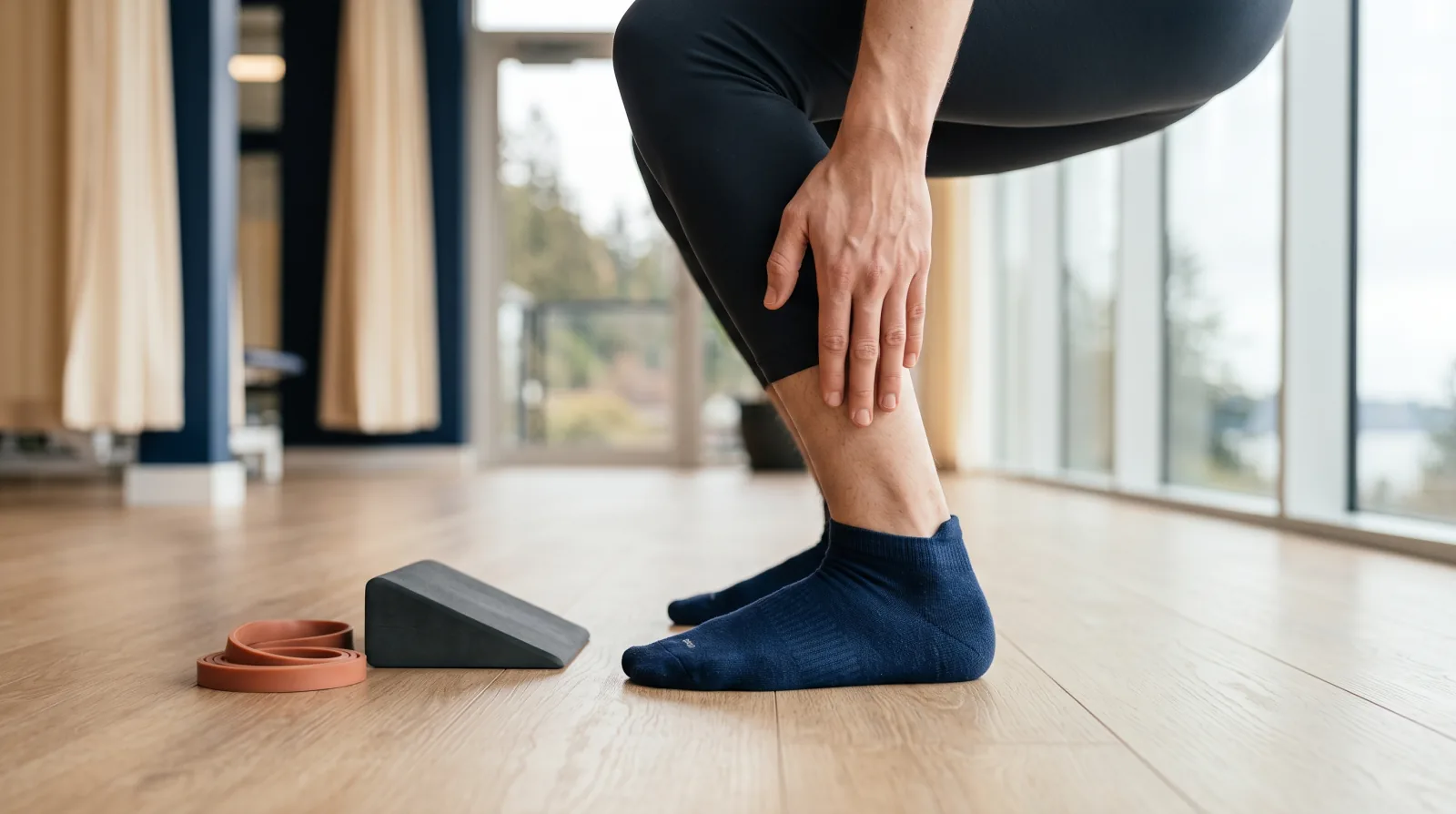
A common shortcut is to raise the heel, with a small wedge or a weightlifting shoe, so the shin can travel further forward without needing as much ankle range. This can be a reasonable, immediate way to keep squatting comfortably while you work on the underlying restriction, and for some people it is a sensible long-term choice. It does not fix the ankle, but it takes the movement out of the range that provokes the compensation.
The other honest option is to accept a shallower squat. Not everyone needs a deep squat, and forcing depth the ankle cannot provide is how the heel lifts, the knee caves, or the low back rounds. Squatting to a depth you can control with a flat foot is better for most people than chasing a deep squat with a heel that pops up. Whether the goal is to improve the ankle, work around it with a heel lift, or simply squat to a controlled depth depends on what you are training for, and it is a decision worth making on purpose rather than by accident. We help sort out which path fits your goals during an assessment.
When to get it checked
If your heels lift, your knees cave, or your squat will not go deep, and stretching has not changed it, an assessment measures your dorsiflexion, sorts out whether the block is muscle or joint, and builds a plan matched to the cause. It is especially worth checking if you also have knee pain with squatting or landing, or a history of ankle sprains.
Book a 30-minute appointment and we will assess your ankle range, test the knee-to-wall on both sides, and give you targeted work that actually improves the movement rather than more generic stretching.
This article is general information about ankle mobility. It is not personal medical advice. A regulated practitioner can confirm whether the patterns described apply to you.
Sources
- Vallandingham et al. - Restoring ankle dorsiflexion range of motion in athletes: an individualized clinical decision-making system, Frontiers in Sports and Active Living (2025)
- Weight-Bearing Lunge Test overview - MAT Assessment
- College of Physical Therapists of BC (CPTBC)
Common questions
Frequently asked questions.
How much ankle dorsiflexion do I need to squat?
It depends on how deep you want to go and your body proportions, but deeper squats push most people toward the limit of their ankle range. A common clinical guide is the knee-to-wall test, where touching the knee to a wall with the big toe roughly a hand's width from the wall reflects enough dorsiflexion for most athletic movement. Less than that often shows up as lifting heels or compensations elsewhere.
Why do my heels lift when I squat?+
Heels lifting at the bottom of a squat is one of the most common signs of limited ankle dorsiflexion. When the shin cannot travel far enough forward over the foot, the body finds range elsewhere, often by rolling onto the toes and lifting the heel. It can also come from a tight calf, a restriction at the ankle joint itself, or a movement habit, which is why an assessment is worth doing.
Is my ankle stiffness from a tight calf or the joint?+
Both are possible, and they need different approaches. A tight calf muscle limits how far the shin can move forward and responds to loading and mobility work for the calf. A block inside the ankle joint, sometimes from an old sprain or bony changes, feels like a firm stop rather than a stretch. We test the difference during an assessment, because stretching a joint that is blocked will not help.
Can limited ankle mobility cause knee pain?+
It can contribute. When the ankle cannot move well, the knee, hip, or trunk often take up the slack, which can load the knee in ways it is not built for during squats, lunges, running, and landing. Limited dorsiflexion has been studied in relation to knee problems. It is rarely the only factor, but it is one worth checking when knee pain shows up with squatting or landing.
How do I improve ankle dorsiflexion?+
It depends on why the range is limited. If a tight calf is the driver, calf loading and mobility work help. If the ankle joint itself is restricted, joint mobilisation and targeted drills are more appropriate. The key is matching the treatment to the cause, which is what the assessment sorts out, rather than stretching hard and hoping.
How can I test my own ankle dorsiflexion at home?+
The knee-to-wall test, also called the weight-bearing lunge test, is a simple, repeatable way to check. Place your foot a set distance from a wall and try to touch your knee to the wall without lifting your heel. A common clinical guide is that touching the knee to the wall with your big toe roughly a hand's width from the wall reflects adequate dorsiflexion for most athletic activities. Noticeably less than that, especially a clear difference between the two sides, points to a restriction worth investigating.
Is using a heel lift or weightlifting shoe to squat deeper a bad idea?+
Not necessarily. A small wedge or a weightlifting shoe lets the shin travel further forward without needing as much ankle range, which can be a reasonable way to keep squatting comfortably while you work on the underlying restriction, and a sensible long-term choice for some people. It does not fix the ankle itself, but it takes the movement out of the range that provokes heel lift, knee cave, or low-back rounding.
Should I just accept a shallower squat instead of fixing my ankle mobility?+
For many people, yes, and that is a reasonable choice, not a compromise. Not everyone needs a deep squat, and forcing depth the ankle cannot provide is how the heel lifts, the knee caves, or the low back rounds. Squatting to a depth you can control with a flat foot is better for most people than chasing a deep squat with a heel that pops up. Whether to improve the ankle, work around it with a heel lift, or squat to a controlled depth depends on what you are training for.
Share this post
Copies a ready-to-publish LinkedIn post to your clipboard and opens the LinkedIn share dialog. Paste the text into the composer and publish.
Written by
Medstar Sport Physio Team
Registered clinician at Medstar Sport Physio & Health, North Vancouver.
This article is for general information only and does not constitute medical advice, diagnosis, or treatment. Individual presentations vary, and assessment findings and treatment plans differ from person to person. If you are experiencing severe symptoms, neurological changes (numbness, weakness, bowel or bladder changes), or a significant trauma, contact your physician or emergency services. Care at Medstar Sport Physio & Health is provided by practitioners registered with their respective British Columbia regulatory colleges.
Filed under
- ankle-mobility
- dorsiflexion
- squat
- knee-pain
- movement
- north-vancouver