
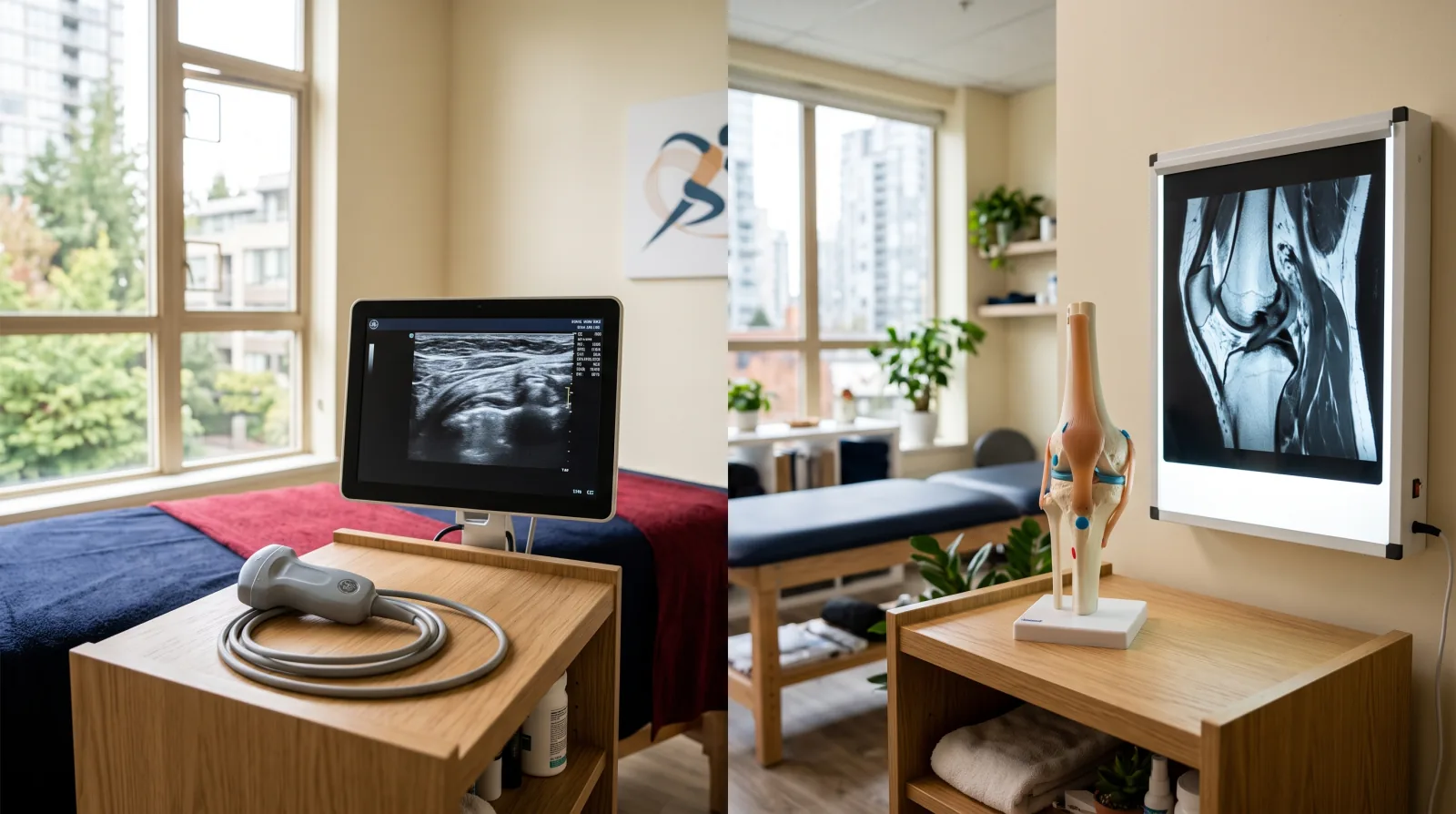
Ultrasound or MRI for a Soft Tissue Injury: How the Choice Actually Gets Made
Two different machines, two different questions. Ultrasound is fast and dynamic. MRI sees deeper and stays the reference standard for the injuries that matter most. Here is how the choice actually gets made.
BY AMIR AHMADI, PHD
Someone lands on ultrasound instead of MRI, or the reverse, and assumes one machine must simply be better than the other. The two scans answer different questions, and the right one depends on the tissue and the decision it needs to inform.
At Medstar Sport Physio in North Vancouver, we think of ultrasound and MRI as tools for different questions rather than a better-versus-worse ranking. Diagnostic ultrasound uses sound waves to show a live, moving picture and performs well for tendons, superficial ligaments, and muscle tears, often with a shorter wait and lower cost. MRI uses a magnetic field to produce a detailed static image and is the stronger tool for deep joint structures, cartilage, and complex tears, remaining the reference standard for many surgical decisions. In British Columbia, physiotherapists cannot order either scan directly. That decision belongs to a physician or nurse practitioner, and our role is identifying when a scan is likely to change the plan.
Two machines, two different pictures
Ultrasound and MRI create images in completely different ways, and that difference is the reason each one suits certain injuries better than others.
Diagnostic ultrasound sends sound waves into the tissue and builds a picture from the echoes that bounce back. The person performing the scan holds a probe against the skin and can move it, and move the joint, while watching the image update in real time. That live, dynamic quality is the technology's biggest strength. MRI uses a strong magnetic field and radio waves to build a detailed, static image, usually taken with the joint held still inside the scanner. It sees further into the body and resolves fine internal detail that ultrasound cannot reach.
Neither approach is a stripped-down or upgraded version of the other. They are built around different physics, and that shows up directly in what each one is good at finding.
Where ultrasound tends to win
Ultrasound performs well for structures that sit close to the skin and for tissue that benefits from being watched in motion. Tendons are the clearest example. A physiotherapist or radiologist can compare the injured Achilles tendon or rotator cuff tendon side by side with the healthy one, move the joint, and watch how the tendon behaves under load in real time, something a static MRI cannot replicate.
The evidence on specific joints backs this up more than people expect. A retrospective cohort study comparing ultrasound and MRI in ankle injuries found ultrasound showed a diagnostic advantage across several ligaments, including full accuracy for the anterior talofibular ligament, the ligament most commonly injured in an ankle sprain. That is a case where the faster, cheaper scan outperformed the more expensive one for the specific structure being asked about.
Ultrasound is also the tool of choice for guiding an injection precisely to a target, for detecting fluid collections such as bursitis or a joint effusion, and for a first look at a suspected muscle tear. Cost and access matter too. Private ultrasound in BC is commonly booked within days, at a lower price point than private MRI, which shortens the path to an answer when the question is one ultrasound can actually answer.
Where MRI tends to win
MRI's advantage shows up once the question moves to deeper or more complex tissue. For a suspected meniscus tear, the structures inside the knee joint sit deep enough that ultrasound has real limits reaching them clearly, which is one reason MRI remains the more established tool for confirming what kind of meniscus problem is present, a distinction we cover in our post on degenerative versus traumatic meniscus tears. For rotator cuff injuries, research comparing the two methods has found MRI more sensitive for partial-thickness tears and for assessing the subscapularis tendon specifically, structures that sit at awkward angles for a surface-based scan to see cleanly.
MRI is also the tool for anything involving bone marrow, cartilage surfaces deep inside a joint, or a full picture of a complex, multi-structure injury, and it remains the reference standard many orthopaedic surgeons use before deciding on an operation. Where a case is heading toward a surgical conversation, an MRI is frequently the scan that conversation is built around.
Why "which is more accurate" is the wrong question
Framing this as a contest between the two technologies misses the point. Accuracy is specific to the tissue and the exact clinical question being asked. Ultrasound can outperform MRI for a superficial ankle ligament and underperform it for a deep partial rotator cuff tear, in the same patient's body, in the same week. The useful question is not "which scan is better" but "which structure needs to be seen, and does the answer change what we do next."
This is also why a physiotherapist's clinical reasoning matters before either scan gets ordered. A proposed framework for point-of-care musculoskeletal ultrasound in physiotherapy practice describes ultrasound competency in tiers, from observing a specific muscle during rehab exercises through to differential diagnosis across the whole musculoskeletal system, with education and governance requirements attached to each tier. The framework treats ultrasound and other imaging as complementary to a solid clinical exam, not a replacement for one.
Who can order these scans in BC
This is where a common assumption trips people up. In British Columbia, physiotherapists do not order diagnostic imaging directly. Physicians and nurse practitioners hold that authority. A physiotherapist's role is to assess whether an imaging finding would actually change the treatment plan, and if it would, to communicate that reasoning to the patient's family physician, who makes the referral. We apply the same reasoning process on the low back, where most cases never need a scan at all, covered in our post on when MRI is actually needed for low back pain.
That process matters because most soft tissue injuries do not need imaging of any kind. A sprained ankle, a mild hamstring strain, or an irritable rotator cuff usually gets diagnosed clinically, through history and a hands-on exam, and managed with a loading program that starts the same week. Imaging becomes relevant when the exam and the early rehab response leave a real question unanswered, not simply because the injury hurts or has lasted a while.
Cost, access, and what that actually buys you
Access differences between the two scans in BC are large enough to shape real decisions. Public MRI wait times commonly run into the months, while private clinics offer appointments within days to two weeks at a meaningful cost. Private ultrasound is typically both faster to book and less expensive than private MRI.
That gap makes it tempting to reach for whichever scan is available soonest. The more useful filter is whether the result changes anything. Paying to confirm a finding that would not alter the rehab plan buys peace of mind rather than a better outcome. Paying to accelerate a scan that is genuinely likely to change the next step, such as before a surgical consultation, is a more defensible use of a private option.
What this looks like at a first visit
When a new patient comes in with a soft tissue injury, the assessment works out whether the presentation fits a pattern we can treat confidently without imaging, or whether something about the history, exam findings, or lack of expected progress raises a genuine question. If imaging looks warranted, we consider which type of scan would actually answer that specific question, whether that is a dynamic look at a tendon or a detailed static view of a structure deep inside a joint, and we put that reasoning in writing to the patient's physician.
Rehab does not usually wait on the imaging decision. Most soft tissue injuries start a graded loading program at the first visit regardless of what happens with a referral, since the biggest driver of recovery for the large majority of these injuries is the rehab itself, not the scan.
The strongest outcomes happen when the scan answers a real question
Ultrasound and MRI are both excellent tools, aimed at different targets. Choosing between them is a matter of matching the technology to the tissue and the decision at hand, not picking the one that sounds more advanced.
If you have a soft tissue injury and are wondering whether imaging fits into your recovery, book a 30-minute assessment and we will work through the clinical picture, decide whether a scan is likely to change the plan, and build the rehab program either way. You can also read about what we treat or reach the clinic here.
This article is general information about diagnostic imaging. It is not personal medical advice. Imaging decisions in British Columbia are made by physicians and nurse practitioners, and a regulated practitioner can confirm whether the patterns described apply to you.
Sources
- Diagnostic performance of ultrasound and magnetic resonance imaging in ankle injuries: a retrospective cohort study, BMC Musculoskeletal Disorders
- Comparison of MRI and High-Resolution Ultrasound in Evaluating Patients With Rotator Cuff Pathologies, PMC
- A proposed framework for point of care musculoskeletal ultrasound and ultrasound image-guided interventions by physiotherapists: scope of practice, education and governance, The Ultrasound Journal
- Magnetic Resonance Imaging (MRI) Prioritization, Government of British Columbia
- College of Health and Care Professionals of BC public registry
Common questions
Frequently asked questions.
Is ultrasound as accurate as MRI for musculoskeletal injuries?
It depends on the injury. For ankle ligament injuries, one retrospective study found ultrasound outperformed MRI across several ligaments and even reached full accuracy for the most commonly injured ankle ligament. For rotator cuff partial tears, MRI is generally considered more sensitive. Accuracy is specific to the tissue and the question being asked, not a fixed ranking between the two machines.
Why would a doctor choose ultrasound over MRI?+
Ultrasound is fast to book, lower cost, and lets the person doing the scan move the joint and compare it side to side in real time, which is useful for tendons and superficial ligaments. It also has no radiation and no confined tube, which matters for some patients. MRI is chosen instead when the structures in question sit deeper, when bone or cartilage detail is needed, or when the case may be heading toward a surgical decision.
Can a physiotherapist order an MRI or ultrasound in BC?+
No. In British Columbia, diagnostic imaging is ordered by physicians and nurse practitioners, not by physiotherapists directly. A physiotherapist's role is to identify when imaging is likely to change the plan, communicate that reasoning to the patient's physician, and continue rehab in parallel while the imaging decision and results come through.
Does everyone with a sports injury need an MRI?+
No. Most soft tissue injuries are managed based on the clinical exam and how the injury responds to a structured rehab program, without any imaging at all. Imaging becomes more relevant when the diagnosis is unclear, when a specific finding would change the treatment plan, or when a case is not progressing as expected after a reasonable trial of rehab.
Is a private MRI or ultrasound worth paying for to skip the wait?+
That depends on whether the result will change what happens next. Public MRI wait times in BC commonly run into the months, while private ultrasound and MRI appointments are often available within days. Paying to confirm a finding that would not change the treatment plan buys reassurance, not a better outcome. Paying to speed up a genuinely decision-changing scan can be worth it, particularly ahead of a surgical consultation.
What is diagnostic ultrasound actually good at detecting?+
It performs well for tendon problems such as tendinopathy and partial tendon tears, superficial ligament injuries, muscle tears, fluid collections such as bursitis or joint effusion, and guiding an injection to the right spot in real time. Its main limitation is that it cannot see through bone and struggles with deep structures, so it is a poor tool for imaging inside a joint that sits far from the skin surface.
What can MRI show that ultrasound cannot?+
MRI sees deep joint structures such as the inside of the knee, hip, or shoulder joint in full detail, including cartilage, ligaments deep inside a joint, bone marrow changes, and the full extent of a complex tear. It does not depend on the skill of the person scanning in the same real-time way ultrasound does, and it produces a single detailed static picture rather than a live moving one.
How does a physiotherapist decide whether to raise the imaging question with my doctor?+
The decision is based on whether the clinical exam and rehab response leave a genuine question that imaging could answer, not on how long the pain has lasted or how much it hurts. If the presentation fits a known pattern and is responding to a structured plan, imaging is unlikely to change that plan. If there is a mismatch between the exam findings and the rehab response, or a red flag, that is when we write to the physician recommending imaging.
Share this post
Copies a ready-to-publish LinkedIn post to your clipboard and opens the LinkedIn share dialog. Paste the text into the composer and publish.

Written by
Amir Ahmadi, PhDDr. Amir Ahmadi is a Registered Physiotherapist, Certified IMS Therapist and former Associate Professor. 20+ years of clinical practice in North Vancouver.
This article is for general information only and does not constitute medical advice, diagnosis, or treatment. Individual presentations vary, and assessment findings and treatment plans differ from person to person. If you are experiencing severe symptoms, neurological changes (numbness, weakness, bowel or bladder changes), or a significant trauma, contact your physician or emergency services. Care at Medstar Sport Physio & Health is provided by practitioners registered with their respective British Columbia regulatory colleges.
Filed under
- diagnostic-ultrasound
- mri
- imaging
- musculoskeletal-injury
- north-vancouver