
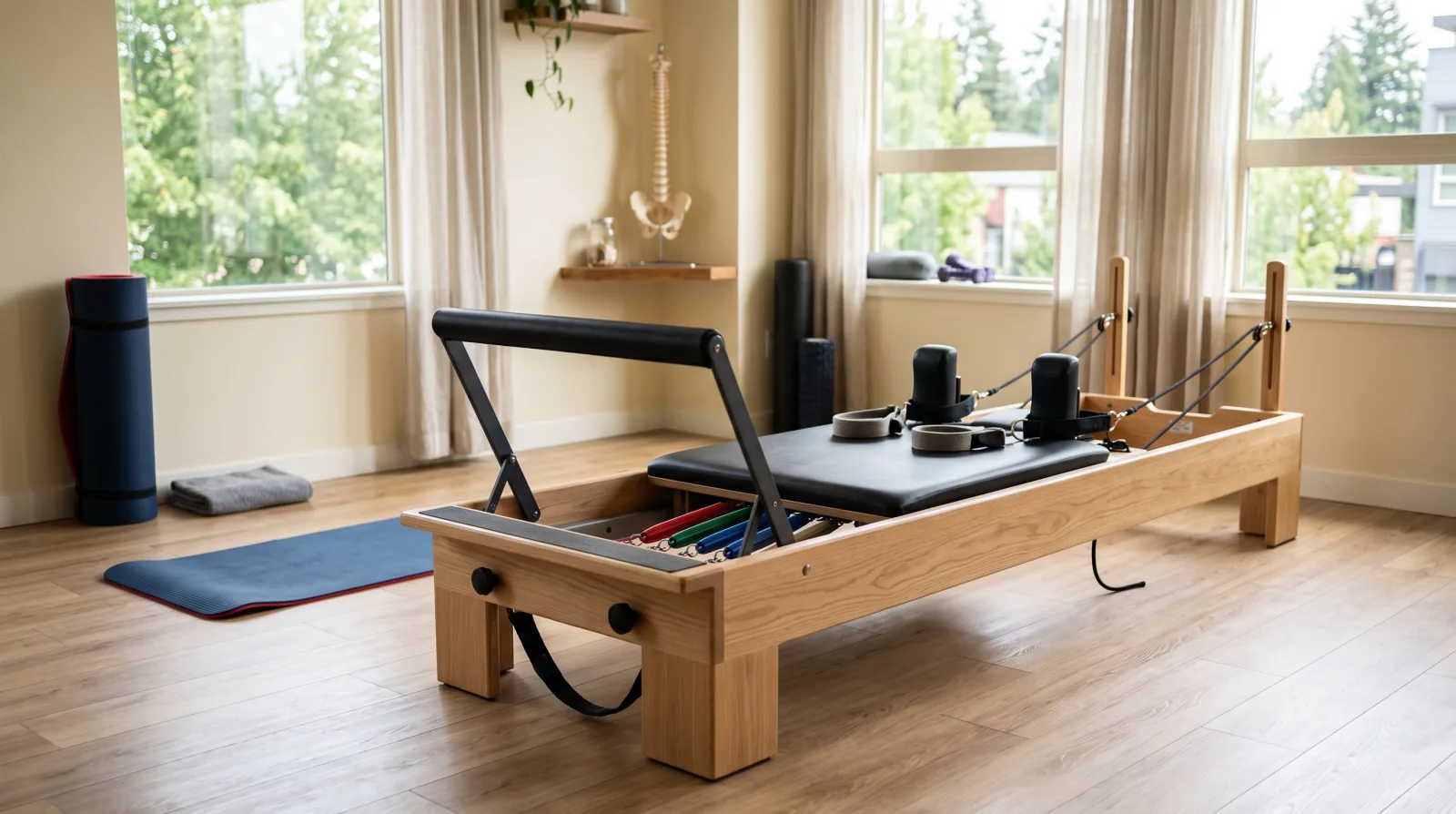
Pilates and Low Back Pain: When a Core Workout Becomes the Cause
Pilates has decent evidence behind it as a treatment for low back pain, which makes it confusing when the class itself is what starts hurting. Here is the gap between the method and how it often gets taught.
BY SANAZ DAVARIAN, PHD
A client who started Pilates specifically to help an old back problem once asked why the class itself had become the thing flaring it up. It is a fair question, and the honest answer is more nuanced than either "Pilates fixes backs" or "Pilates hurts backs."
Pilates-related low back pain usually comes from how an exercise is loaded, not from the method itself. Exercises that combine spinal flexion with a long lever arm, such as the roll-up and teaser, or extension-based moves like swan, can aggravate a sensitive back when repeated with poor control or high volume. At Medstar Sport Physio in North Vancouver, we treat this by identifying which specific movements provoke the pain and adjusting the exercise, the load, or the control strategy, rather than assuming Pilates itself needs to be dropped.
Two things that are both true
Pilates carries genuine evidence as a treatment option for low back pain. A Cochrane systematic review of Pilates for low back pain, covering 10 randomised controlled trials and 510 participants, found low to moderate quality evidence that Pilates is more effective than minimal intervention for pain and disability, with no adverse events reported across the included trials. The same review is honest about its limits: there is no conclusive evidence that Pilates outperforms other structured forms of exercise, so the choice often comes down to preference and access rather than one method being clinically superior.
At the same time, back pain during or after a Pilates class is a real thing clinics see, and it deserves a real explanation rather than dismissing it as impossible because "Pilates is good for backs." Both statements can be accurate. A method with solid group-level evidence for reducing back pain can still aggravate an individual spine when a specific exercise is loaded in a way that spine cannot yet tolerate.
The exercises that ask the most of the low back
A handful of classic Pilates movements combine spinal flexion, curling the trunk forward, with a long lever arm created by extended arms or legs. The roll-up, the teaser, and some variations of the hundred fall into this category. These exercises are built to challenge deep trunk control, and when the deeper abdominal and pelvic floor muscles are doing their job, the lumbar spine stays relatively supported through the movement.
The problem shows up when those deeper muscles are not yet strong or coordinated enough to control the position, and the low back and hip flexors take over instead. Repeated over many reps and many classes, that compensation pattern is a plausible route to irritation, even though no single rep looks dangerous. Extension-based exercises like swan work the opposite direction, and the same principle applies: control matters more than the direction of the movement.
None of this makes any specific exercise inherently unsafe. It makes exercise selection and technique the variables that actually determine whether a given back tolerates the class or not.
Why the people teaching it are not immune either
One of the more telling pieces of evidence on this topic does not come from patients at all. A survey of 166 Pilates instructors in Brazil found low back pain reported by 63.3 percent of respondents and neck pain by about 62 percent. Higher rates were linked to frequently performing physical effort, working standing, using a computer, and feeling consistently stressed.
That is a striking number for people whose profession is built around a method with a reputation for fixing backs. The explanation is not that the method fails. It is that teaching Pilates is a different physical job than taking a class. Instructors demonstrate repeatedly, hold positions to correct students, and stand through long sessions, all of which add a volume and posture demand that a once-a-week student never experiences. It is a reminder that the exposure and dose matter more than the exercise's reputation.
Volume is often the quiet variable
A single well-executed roll-up is not the injury. The injury pattern, when it happens, tends to build from repetition: the same flexion-heavy sequence, class after class, week after week, without enough variation or enough underlying strength to support it. This is the same load-management logic that runs through almost every overuse injury we see, whether the activity is running, lifting, or a mat class. A back that is asked to do the same specific movement pattern at a volume beyond its current tolerance will eventually let you know.
This is also why "more Pilates" is not automatically a safe answer for someone whose back already hurts from Pilates. Understanding which specific exercises and how much volume triggered the pain matters more than assuming any general increase in core work will fix it.
Where a modified program fits
The practical answer for someone whose back reacts to a Pilates class is rarely "quit Pilates entirely" or "push through the pain." It is closer to identifying which specific movements are the aggravating ones, since a class typically covers a wide range of flexion, extension, and rotation patterns, and a sore back afterward often traces to one or two exercises rather than the whole sequence.
From there, a program can modify or temporarily remove the provoking movements, build the specific deep trunk control that was missing, and reintroduce the fuller class gradually as that control improves. This is close to what thoracic mobility work does for a stiff mid-back that is forcing compensation elsewhere in the spine: the goal is not avoidance, it is closing the specific gap that is causing the compensation.
Clinical Pilates versus a studio class
This is also where Clinical Pilates differs meaningfully from a general studio class. Clinical Pilates is Pilates-based exercise delivered or supervised by a physiotherapist and built around an individual assessment of your spine, your movement pattern, and your current stage of recovery, rather than a standard sequence paced for a group of mixed ability. A studio instructor teaching fifteen people at once cannot individualise load the way a one-on-one clinical session can.
For someone whose back has flared with Pilates, or who has a known back history and wants to start Pilates safely, working through a clinical program first, then transitioning into a studio class once control is established, is often the more reliable route than jumping straight into a general class and hoping it goes well.
What this means if your back reacts to Pilates
A sore back after a class is not proof that Pilates is wrong for you, and it is not something to ignore either. It is a signal that something in the specific sequence, the volume, or your current control does not match what was asked of your spine that day. Working out which of those it is, rather than guessing, is what separates a program that helps your back from one that quietly keeps aggravating it.
When to get it assessed
Mild soreness that settles within a day and does not build over successive classes is common and often responds to a technique adjustment alone. Pain that is sharp, that spreads down a leg, that comes with numbness or tingling, or that keeps building session over session deserves a proper assessment rather than more guessing about which exercise is to blame.
Book a 30-minute assessment and we will identify which movements are provoking your back, check your spinal control and mobility, and build a modified plan so you can keep training without the same flare-up returning every few classes. You can see what we treat or reach the clinic here.
This article is general information about Pilates-related low back pain. It is not personal medical advice. A regulated practitioner can confirm whether the patterns described apply to you.
Sources
- Pilates for low back pain, Cochrane systematic review summary, São Paulo Medical Journal (2015)
- Pilates instructors: prevalence of musculoskeletal pain, associated occupational factors and comparison of quality of life relative to Brazilian reference values (PubMed)
- College of Physical Therapists of BC (CPTBC)
Common questions
Frequently asked questions.
Can Pilates cause low back pain?
Yes, for some people, even though Pilates is more often recommended as a treatment for low back pain than a cause of it. The usual mechanism is not the method itself but how an exercise is loaded: repeated spinal flexion or extension performed with poor control, too much volume too soon, or an exercise that does not suit a particular spine. A survey of Pilates instructors found low back pain reported by 63.3 percent of respondents, so even people who teach it are not immune.
Is Pilates supposed to help back pain, not cause it?+
Both can be true, because it depends on execution rather than the method's reputation. Systematic review evidence supports Pilates as one reasonable option among several exercise approaches for non-specific low back pain, with no strong evidence that it beats other structured exercise. The same movements that build core control when done well can aggravate a sensitive back when the load, repetition, or technique is off for that person.
Which Pilates exercises are hardest on the low back?+
Exercises that combine spinal flexion with a long lever arm, such as the roll-up, teaser, and some hundred variations, ask the low back and hip flexors to do more work if the deeper trunk muscles are not controlling the movement well. Extension-based exercises like swan can load the low back the other direction if performed with poor control. Neither exercise is automatically unsafe. The risk comes from doing high volume of either pattern without the control to support it.
Why do Pilates instructors themselves get so much back pain?+
A survey of 166 Pilates instructors in Brazil found low back pain reported by 63.3 percent of respondents and neck pain by about 62 percent, with higher rates linked to frequent physical effort, standing for long periods, and occupational stress. Teaching Pilates involves demonstrating repeatedly, correcting positions by hand, and standing through long sessions, which is a different physical demand than taking one class a week as a student.
Should I stop doing Pilates if my back hurts during class?+
Not automatically, but a back that flares during or after Pilates deserves attention rather than pushing through. The first step is usually identifying which specific movements provoke it, since Pilates covers a wide range of flexion, extension, and rotation patterns, and a sore back after class often traces to one or two specific exercises rather than the whole practice. A modified program that removes or adjusts those movements while building control can often let you keep training.
What is Clinical Pilates and how is it different from a studio class?+
Clinical Pilates is Pilates-based exercise delivered or supervised by a physiotherapist, adapted to an individual's specific injury, movement pattern, and stage of rehabilitation, rather than a standard sequence taught to a group. A studio class is built for a general population and paced for the group. Clinical Pilates starts from an assessment of your spine and adjusts which exercises, loads, and ranges are appropriate for you specifically.
How do I know if my Pilates-related back pain needs an assessment?+
Pain that is mild, settles within a day, and does not worsen over successive classes is common and often resolves with a technique adjustment. Pain that is sharp, that spreads into a leg, that comes with numbness or tingling, or that keeps building session over session needs a proper assessment. A physiotherapist can determine whether the issue is a specific exercise, a training volume problem, or an underlying spinal issue that Pilates is aggravating rather than causing.
What happens at a physiotherapy assessment for Pilates-related back pain?+
The physiotherapist asks which exercises and positions bring on the pain, how long it has been happening, and your overall Pilates and exercise history, then examines your lumbar spine movement, control, and strength. Watching how you perform a few provoking movements often reveals whether the low back is compensating for limited hip mobility or weak deep trunk control. From there, the plan adjusts your Pilates practice and may add specific strengthening before you return to the full class.
Share this post
Copies a ready-to-publish LinkedIn post to your clipboard and opens the LinkedIn share dialog. Paste the text into the composer and publish.

Written by
Sanaz Davarian, PhDDr. Sanaz Davarian is a Registered Physiotherapist with a PhD and 20+ years of experience. Certified IMS Therapist, former Assistant Professor of Physiotherapy. North Vancouver.
This article is for general information only and does not constitute medical advice, diagnosis, or treatment. Individual presentations vary, and assessment findings and treatment plans differ from person to person. If you are experiencing severe symptoms, neurological changes (numbness, weakness, bowel or bladder changes), or a significant trauma, contact your physician or emergency services. Care at Medstar Sport Physio & Health is provided by practitioners registered with their respective British Columbia regulatory colleges.
Filed under
- pilates
- low-back-pain
- core-stability
- spinal-flexion
- clinical-pilates
- north-vancouver


