
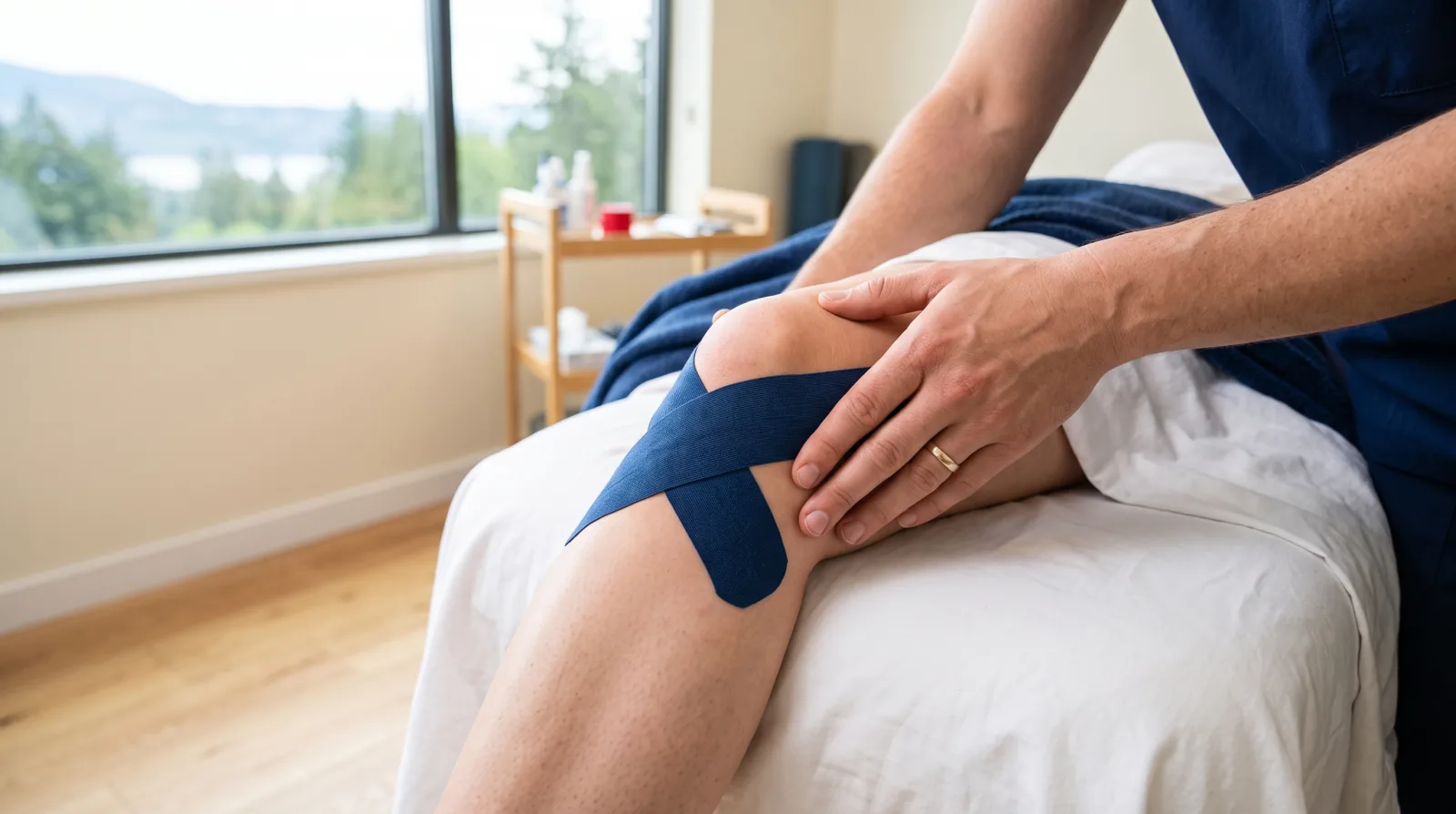
Kneecap Taping for Patellofemoral Pain: What the Evidence Actually Shows
A strip of tape across the kneecap can take the edge off patellofemoral pain fast. The research says it is a short-term aid, not the fix, and the two taping methods work through different routes.
BY ALI SHAFIEI, RPT
A strip of tape across the kneecap is one of the first things people associate with runner's knee, sitting right next to foam rolling and knee sleeves. The research on whether it actually helps is more specific than most people expect.
At Medstar Sport Physio in North Vancouver, we use kneecap taping as a short-term aid for patellofemoral pain, not as the treatment itself. A meta-analysis of 455 patients found Kinesio taping produces a small but real reduction in pain compared with no tape, while rigid McConnell taping shows mixed results across trials and has not been shown on imaging to meaningfully reposition the kneecap once a person is standing and moving. Taping works best in the first weeks of a loading program that strengthens the hip and the knee together, which is what the evidence supports as the main driver of recovery.
What patellofemoral pain is, briefly
Patellofemoral pain, often called runner's knee, is an ache around or behind the kneecap that flares with running, stairs, squatting, and sitting with the knee bent for a long time. It is usually a load problem: the joint under the kneecap is being asked to handle more than it currently tolerates, not a sign of structural damage. We cover the full picture, including how it differs from IT band syndrome and patellar tendinopathy, in our guide to runner's knee. Taping sits inside that broader plan, and it only makes sense once patellofemoral pain is the confirmed diagnosis rather than one of the conditions it gets mistaken for.
The two taping methods are not the same technique
People use "kneecap tape" as one phrase, but there are two distinct methods with different histories and different proposed mechanisms.
McConnell taping is the older method, developed as a rigid strip applied firmly to pull the kneecap toward the inner side of the knee. It was designed specifically to correct patellar position and tracking during movement, on the idea that a kneecap tracking slightly outward was the source of pain.
Kinesio taping is newer, elastic, and applied with much lighter tension. It does not attempt to pull the kneecap anywhere. The proposed mechanism is closer to stimulating the skin and the muscles around the knee, which may change how pain is processed and how well the surrounding muscles activate.
Does taping actually move the kneecap
This is the part that surprises a lot of patients. A study examining patellofemoral joint alignment and contact area during weight bearing tested whether McConnell-style medial glide taping and Kinesio taping produced a measurable mechanical change in how the kneecap sits and contacts the thigh bone once someone is standing and loading the joint. Neither taping method produced a clear mechanical correction of alignment or contact area in that setting.
That finding does not mean taping is useless. It means the pain relief people feel from tape is probably not coming from the kneecap being physically repositioned, at least not once weight is on the leg. Whatever benefit exists is likely coming from a different route, such as sensory input through the skin or an effect on how the surrounding muscles fire.
What the pooled evidence on pain actually shows
A systematic review and meta-analysis comparing Kinesio taping and McConnell taping for patellofemoral pain syndrome pooled 11 controlled trials. For Kinesio taping, pooling data from 455 patients across the included trials, the analysis found a small but statistically real effect on pain reduction. For McConnell taping, the pooled data from 160 patients showed more inconsistent, heterogeneous results across the trials, meaning some studies found a benefit and others did not.
The same review found Kinesio taping showed a small improvement in motor function and a moderate improvement in muscle activity around the knee compared with McConnell taping in the trials that measured those outcomes. In plain terms: Kinesio tape has a more consistent, if modest, pain benefit across the pooled data, and some signal of helping the surrounding muscles work better. McConnell tape's evidence on pain is a mixed bag.
Where taping fits in a real treatment plan
The JOSPT clinical practice guideline on patellofemoral pain addresses taping directly, and its framing matters as much as the evidence grade attached to it. Taping is recommended as something a physiotherapist may apply early in treatment to help reduce pain and improve function, used alongside the exercise program, not instead of it.
That sequencing is deliberate. The same guideline's strongest evidence points toward exercise therapy that strengthens the hip and the knee together as the treatment that reduces pain and improves function over time, a finding we go through in detail in our runner's knee guide. Taping's job in this plan is narrower: calm an irritable knee enough, for long enough, that a person can actually tolerate doing the strengthening work. It is a bridge to the exercise, not a replacement for it.
Why "small effect" can still be clinically useful
It is fair to ask why a physiotherapist would bother with a treatment that a meta-analysis calls a small effect. The honest answer is that a small, real reduction in pain during the first few weeks of a loading program can decide whether someone sticks with the plan or gives up on it.
Patellofemoral pain often flares early in a strengthening program, before the muscles have adapted. If tape takes the edge off that flare and keeps someone doing their exercises through week two and three, it has done its job, even though it never touched the actual driver of the pain. We think of it the same way we think about a brief course of activity modification: useful for buying tolerance in the short term, not a long-term strategy on its own.
What taping does not do
Taping does not build hip or knee strength. It does not change running mechanics permanently. It does not resolve the underlying capacity gap between what the joint can currently handle and what a person is asking it to do. A person who tapes their knee for months without progressing a strengthening program is treating a symptom repeatedly rather than closing the gap that caused it.
There is also a minor practical limit worth naming: repeated daily taping on the same patch of skin can cause irritation, redness, or blistering under the adhesive, especially with rigid tape applied with firm tension. If that happens, stopping and letting the skin recover matters more than pushing through for the sake of the taping schedule.
Choosing tape as part of your own plan
If you are dealing with patellofemoral pain and considering taping, the more useful question is not "does tape work" but "what is it buying me right now." If your knee is too irritable to tolerate the loading exercises the evidence supports, a few weeks of taping alongside a graded start to that program is a reasonable use of it. If your knee already tolerates loading reasonably well, going straight to the strengthening work without tape is just as valid, since the tape's effect is modest on top of a program that is already doing the heavier lifting.
An assessment sorts out which situation you are in, confirms patellofemoral pain is actually the diagnosis, and matches the taping approach, if any, to what your knee needs at that stage.
The strongest outcomes happen when taping supports the plan, not replaces it
Taping the kneecap can take a real amount of pain off an irritable knee in the first weeks of rehab, and it does that whether the technique is rigid McConnell tape or elastic Kinesio tape, through routes that likely have little to do with physically repositioning the joint. The gains that last come from the hip and knee strengthening program running underneath it.
If runner's knee has been slowing you down and you are wondering whether taping is worth trying, book a 30-minute appointment and we will confirm the diagnosis, decide whether taping fits your current stage, and build the loading plan that does the longer-term work. You can also read more about what we treat or reach the clinic here.
This article is general information about patellofemoral pain and taping. It is not personal medical advice. A regulated practitioner can confirm whether the patterns described apply to you.
Sources
- Effects of Kinesio Taping versus McConnell Taping for Patellofemoral Pain Syndrome: A Systematic Review and Meta-Analysis, PMC
- Effects of Patellofemoral Taping on Patellofemoral Joint Alignment and Contact Area During Weight Bearing, JOSPT (2017)
- Patellofemoral Pain: Clinical Practice Guidelines, JOSPT (2019)
- College of Health and Care Professionals of BC public registry
Common questions
Frequently asked questions.
Does taping the kneecap actually reduce pain?
For many people, yes, in the short term. A meta-analysis pooling 455 patients found Kinesio taping produced a small but real pain reduction compared with no taping. Studies on McConnell taping, an older rigid-tape technique, show mixed results across trials. Neither method is a cure. Both are best used to make the first few weeks of a loading program more tolerable.
What is the difference between Kinesio tape and McConnell tape for kneecap pain?+
Kinesio tape is an elastic strip applied with light tension, and research suggests its pain relief comes mainly from stimulating the skin and muscle activity around the knee rather than from moving the kneecap. McConnell tape is rigid, applied firmly to pull the kneecap toward the inner knee, and was designed to correct kneecap position and tracking. Imaging studies have not confirmed that either technique meaningfully repositions the kneecap once someone is standing and moving.
Does taping fix why my kneecap hurts?+
No. Taping does not address the muscle strength or movement pattern that usually drives patellofemoral pain. The JOSPT clinical practice guideline on patellofemoral pain includes taping as an early adjunct, meant to be combined with exercise, not used on its own. The exercise program targeting the hip and knee together is what rebuilds the joint's tolerance to load.
How long should I use tape for kneecap pain?+
Most protocols use tape for the first few weeks, during the period when pain is highest and the loading program is just starting. As strength builds and the knee tolerates more activity without a flare, most people can wean off tape without symptoms returning. Relying on tape for months without progressing the exercise side of the plan usually means the underlying capacity problem has not been addressed.
Can I tape my own knee at home for runner's knee?+
You can try over-the-counter kinesiology tape for a training session, but getting the exact technique and tension wrong reduces any benefit and can irritate the skin. A physiotherapist can show you a specific application matched to how your knee responds, and confirm that patellofemoral pain, not IT band syndrome or patellar tendinopathy, is actually what you have before building a plan around it.
Does tape work better than a knee brace or sleeve for patellofemoral pain?+
The evidence does not clearly favour one over the other, and the JOSPT guideline advises against relying on braces, sleeves, or straps as a stand-alone fix, in the same way taping is not a stand-alone fix. Both are supporting tools for the early, most irritable phase. What is not optional, according to the guideline, is the exercise program that targets the hip and the knee.
Why does my physiotherapist tape my knee if the evidence is only 'small' benefit?+
A small, real reduction in pain in the first weeks can be the difference between someone tolerating a loading program and avoiding the activity that would otherwise help them recover. Taping is not chosen because it fixes the joint. It is chosen because it can make an irritable knee calm enough, for long enough, to do the exercises that actually rebuild the knee's capacity.
Is skin irritation from kneecap tape common?+
It can happen, especially with repeated daily application over the same skin, or with adhesives left on too long. Redness, itching, or blistering under the tape is a reason to stop and let the skin recover before reapplying, and to ask about a different tape product or a different application pattern. It is a minor but real practical limit on how long taping can be used continuously.
Share this post
Copies a ready-to-publish LinkedIn post to your clipboard and opens the LinkedIn share dialog. Paste the text into the composer and publish.

Written by
Ali Shafiei, RPTAli Shafiei is a Registered Physiotherapist with 10+ years of clinical experience in musculoskeletal, neurological and sports rehabilitation. North Vancouver.
This article is for general information only and does not constitute medical advice, diagnosis, or treatment. Individual presentations vary, and assessment findings and treatment plans differ from person to person. If you are experiencing severe symptoms, neurological changes (numbness, weakness, bowel or bladder changes), or a significant trauma, contact your physician or emergency services. Care at Medstar Sport Physio & Health is provided by practitioners registered with their respective British Columbia regulatory colleges.
Filed under
- patellofemoral-pain
- runners-knee
- kinesio-taping
- mcconnell-taping
- knee-taping
- north-vancouver