
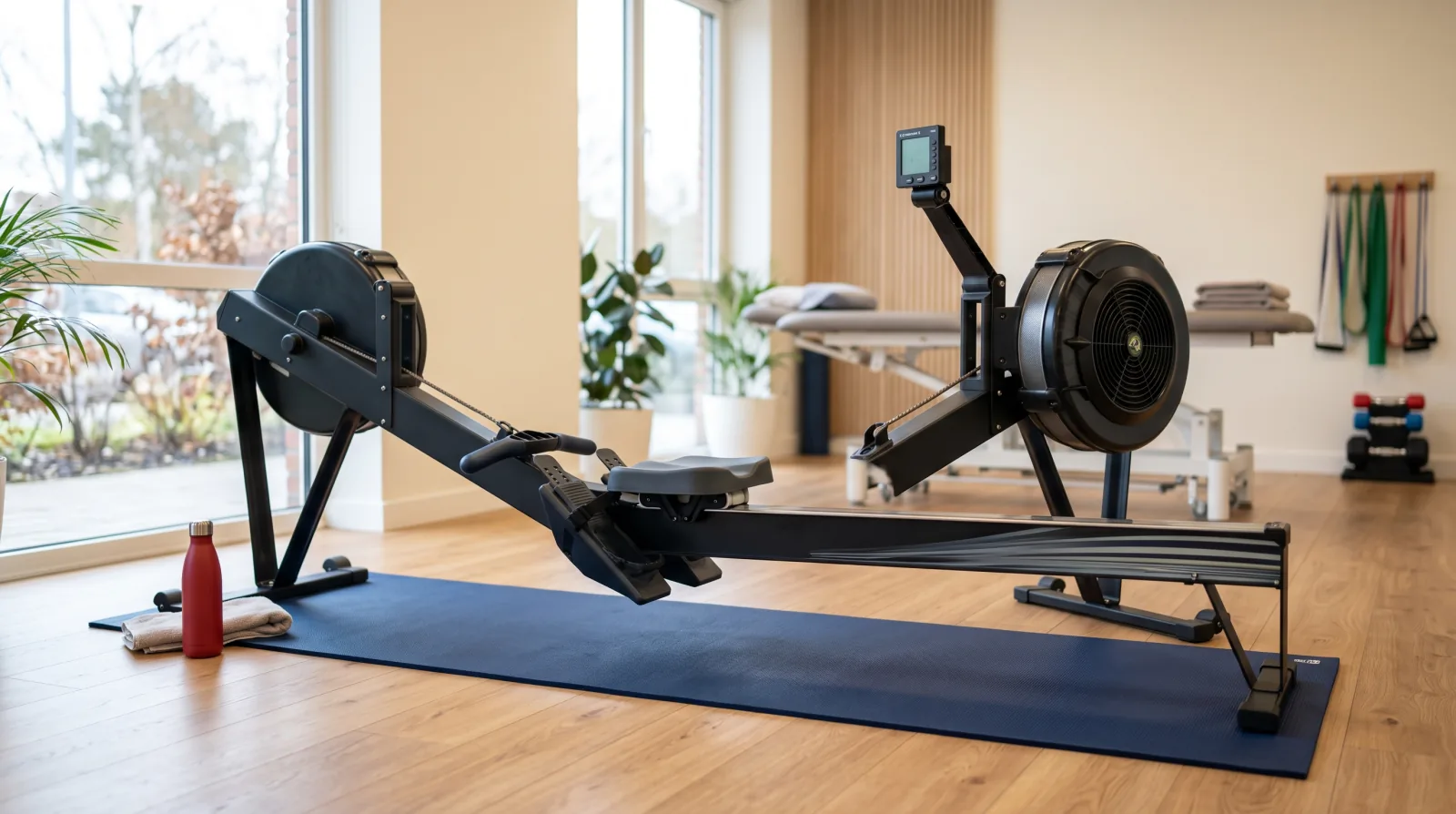
Rowing Machine Back Pain: The Technique Errors Behind Most Erg Injuries
A sore lower back after erg pieces is common, and it usually is not bad luck. It is a technique pattern and a training-volume pattern that both point the same direction.
BY AMIR AHMADI, PHD
A sore lower back after a hard piece on the rowing machine is one of the more common complaints we hear from North Shore rowers, and it usually is not random bad luck. It traces to a specific point in the stroke and a specific pattern of fatigue, both of which are fixable.
Rowing machine back pain most often comes from rounding through the lower back at the catch, the compressed position at the front of the stroke, instead of reaching forward mainly through the hips and pelvis. Long, unbroken erg pieces make this worse as the back muscles fatigue and stop controlling the spine as well. At Medstar Sport Physio in North Vancouver, the fix usually combines a technique correction at the catch with a training-volume adjustment, since a previous episode of back pain is the single strongest predictor of the next one.
Where the stroke actually loads your back
The rowing stroke has two ends: the catch, where you are compressed forward with knees bent and arms extended, and the finish, where you lean back slightly with the handle at your body. Most of the technique conversation about back pain centres on the catch, because that is where the spine is asked to do the most work if the hips are not doing their share.
Getting into the catch position requires forward reach, and that reach can come from two places: rotating forward at the hips and pelvis, or rounding the lumbar spine. A systematic review of the relationship between rowing-related low back pain and rowing biomechanics found that rowers without a history of back pain tend to show neutral or slightly forward pelvic rotation at the catch and get more of their hip range used, while rowers with low back pain spend more time in increased lumbar flexion during the drive phase. The pelvis moves less, the low back moves more, and the load shifts to tissue that was not built to do that job stroke after stroke.
Why the erg is often worse than the boat
Anecdotally, a lot of rowers notice their back bothers them more on the machine than on the water, and there is a biomechanical reason for that. Comparisons of ergometer rowing to on-water rowing have found greater lumbar flexion and a greater maximum flexion angle on the ergometer, and in both settings, fatigue increases lumbar spine flexion at the catch, with a larger effect on the erg than in a boat.
Put simply, a fixed machine does not move the way a boat does under you, and the compensations a tired back makes late in a piece show up more on a stationary erg. This does not mean the erg is inherently unsafe. It means the same technique fault gets amplified there, which is exactly why so many rowers report the erg as the place their back complains first.
The fatigue problem inside a long piece
A single stroke with slightly more lumbar flexion than ideal is not the injury. Hundreds of strokes in that pattern, especially as the muscles supporting the spine get tired, is where the load accumulates. As the back extensor muscles fatigue during a long, continuous piece, control over the lumbar spine's position degrades, which is part of why technique tends to break down later in a piece rather than at the start.
This matters for how training is structured, not just how a single stroke looks. A rower who has good form for the first ten minutes and then quietly rounds through the low back for the last ten is loading the spine differently across that one session than the stroke count alone would suggest.
What the evidence actually says about training volume
It would be convenient to say "row less" and call the problem solved, but the research on training volume is genuinely mixed, and it is worth being straight about that rather than picking the number that sounds best.
Earlier work, including a study on ergometer training volume and previous injury as predictors of back pain in rowing, identified history of lumbar spine injury and volume of ergometer training as the most significant risk factors for a new episode. A broader scoping review of the peer-reviewed literature on low back pain in rowing similarly found reasonable evidence that prolonged ergometer use and a history of low back pain both act as risk factors.
A more recent systematic review and meta-analysis of risk factors for low back pain in rowers, pooling data across ten studies and over 2,000 athletes, complicates that picture. It found that total training volume was not a statistically significant predictor once analysed across the pooled data, while a history of previous low back pain remained strongly associated with future episodes, with athletes who had a prior episode roughly two and a half times more likely to have a recurrence. The authors also rated the overall evidence quality as low, so neither finding should be treated as the final word.
What holds up across nearly every study is the previous-injury link. If you have had rowing-related back pain before, your back is the part of this equation most worth paying attention to, more than any specific weekly kilometre count.
Where equipment and setup fit
Seat height, footplate angle, and handle height are all adjustable on most machines, and a setup that forces extra reach or an awkward catch position can push someone toward more lumbar flexion regardless of how well they understand the technique cue. This is a smaller factor than the stroke pattern itself, but it is worth checking, particularly for someone using a home machine set up once and never revisited.
Sweep rowing, where each rower holds one oar and the trunk rotates asymmetrically, has also been associated with a higher rate of low back pain than sculling in some of the literature, likely related to the extra rotational load through the spine. That distinction matters more for on-water training than for erg work, but it is part of the same picture of load through the low back.
Building the fix into your training
The practical version of all this research is straightforward, even if the studies behind it are not unanimous. Reach forward at the catch mainly through the hips and pelvis, keeping the low back closer to neutral rather than rounding to close the last few centimetres of the stroke. Break long steady-state pieces into intervals where possible, particularly while a sensitive back is settling, since this limits the time spent in the more flexed, fatigued version of the stroke. If you have had back pain from rowing before, treat that history as your biggest single risk factor and build your training volume back up gradually rather than jumping straight to your previous distance.
This is the same load-management thinking that applies to almost any repetitive-motion injury: correct the pattern doing the damage, then rebuild tolerance in stages rather than avoiding the activity altogether or pushing through pain and hoping it settles on its own. Thoracic spine stiffness is also worth checking in rowers with recurring back complaints, since a stiff mid-back can push more of the catch's forward reach down into the lumbar spine than it should carry.
When to get it assessed
A back that is sore after erg sessions and settles within a day or two with reduced volume is common and often responds well to the technique and load adjustments above. Pain that is sharp, that spreads down a leg, that comes with numbness or tingling, or that does not ease with a few days of reduced rowing deserves a proper assessment rather than more trial and error at home.
Book a 30-minute assessment and we will watch your stroke, check your hip and thoracic mobility, and build a plan that adjusts your technique and your training volume together, so you can keep rowing without the same complaint returning every season. You can see what we treat or reach the clinic here.
This article is general information about rowing machine back pain. It is not personal medical advice. A regulated practitioner can confirm whether the patterns described apply to you.
Sources
- The relationship between rowing-related low back pain and rowing biomechanics: a systematic review (PubMed)
- Ergometer training volume and previous injury predict back pain in rowing; strategies for injury prevention and rehabilitation (PubMed)
- Examining the Peer-Reviewed Published Literature Regarding Low Back Pain in Rowing: A Scoping Review, International Journal of Sports Physical Therapy (2023)
- Risk factors associated with low back pain in rowers: a systematic review and meta-analysis, BMC Sports Science, Medicine and Rehabilitation (2025)
- College of Physical Therapists of BC (CPTBC)
Common questions
Frequently asked questions.
Why does my lower back hurt after using the rowing machine?
The most studied pattern is rounding through the lower back at the catch, the compressed position at the front of the stroke, instead of getting that forward reach mostly from the hips and pelvis. Rowers with a history of low back pain tend to spend more time in that flexed position during the drive than rowers without pain. Long, unbroken pieces on the machine can make the pattern worse as the back extensor muscles fatigue and stop holding the spine as well.
Is rowing bad for your back?+
Not inherently. Rowing loads the back the way most exercise loads a body part, and a well-conditioned back tolerates that load well. The concern is less about rowing itself and more about how much lumbar flexion happens at the catch and how long a single unbroken piece runs. A back that already has a history of pain and low tolerance for that specific loading pattern is more likely to react to it.
What is the correct way to move at the catch on a rowing machine?+
The general technique principle supported in the rowing literature is getting more of the reach forward from rotating the pelvis and hips, and less from rounding the lumbar spine. In practice this often means hinging from the hips with a comparatively flat back, rather than curling the low back forward to reach the flywheel. A coach or physiotherapist watching your stroke from the side can usually spot which pattern you are using.
Does training volume on the erg actually cause back pain?+
The evidence is mixed. Some studies have linked ergometer training volume to low back pain risk in rowers, and prolonged ergometer use in particular has reasonable support as a risk factor. A larger recent meta-analysis, however, did not find total training volume to be a statistically significant predictor once other factors were accounted for. What comes through consistently across studies is that a previous episode of low back pain is the strongest predictor of another one, more than any single volume number.
Should I stop rowing if my back hurts?+
Not automatically. A back that is irritated by rowing usually responds to reducing the volume and intensity of erg pieces for a period, correcting the pattern that is loading it, and building capacity back up in stages, rather than stopping altogether and starting cold later. Sharp pain, pain running down a leg, or numbness are different and need an assessment before you keep rowing at all.
How long should an unbroken piece on the erg be if my back is sensitive?+
There is no fixed safe number for every rower, since it depends on your back's current tolerance, your technique, and your training history. What the literature points to is that fatigue during long, continuous pieces increases lumbar flexion at the catch, and this effect is larger on a stationary ergometer than in a boat. Breaking a long piece into intervals, or shortening pieces while a sensitive back settles, reduces the amount of time spent in that fatigued, more flexed position.
What happens at a physiotherapy assessment for rowing-related back pain?+
The physiotherapist takes a history of your training volume, when the pain started, and whether it is new or a repeat of an old injury, then examines your lumbar spine, hip mobility, and trunk control. Watching a few strokes on the machine, or reviewing video of your stroke, often reveals whether the pattern loading your back is happening at the catch, the finish, or through fatigue late in a piece. From there the plan adjusts technique, training volume, or both.
Is physiotherapy for rowing back pain covered by extended health insurance?+
Most BC extended health plans that include a physiotherapy benefit cover assessment and treatment for rowing-related back pain the same as any other sport injury. Direct billing lets the clinic bill your insurer directly rather than you paying upfront and claiming it back. If you are unsure what your plan covers, the clinic can help clarify before you book.
Share this post
Copies a ready-to-publish LinkedIn post to your clipboard and opens the LinkedIn share dialog. Paste the text into the composer and publish.

Written by
Amir Ahmadi, PhDDr. Amir Ahmadi is a Registered Physiotherapist, Certified IMS Therapist and former Associate Professor. 20+ years of clinical practice in North Vancouver.
This article is for general information only and does not constitute medical advice, diagnosis, or treatment. Individual presentations vary, and assessment findings and treatment plans differ from person to person. If you are experiencing severe symptoms, neurological changes (numbness, weakness, bowel or bladder changes), or a significant trauma, contact your physician or emergency services. Care at Medstar Sport Physio & Health is provided by practitioners registered with their respective British Columbia regulatory colleges.
Filed under
- rowing-machine
- erg
- low-back-pain
- rowing-technique
- load-management
- north-vancouver


