
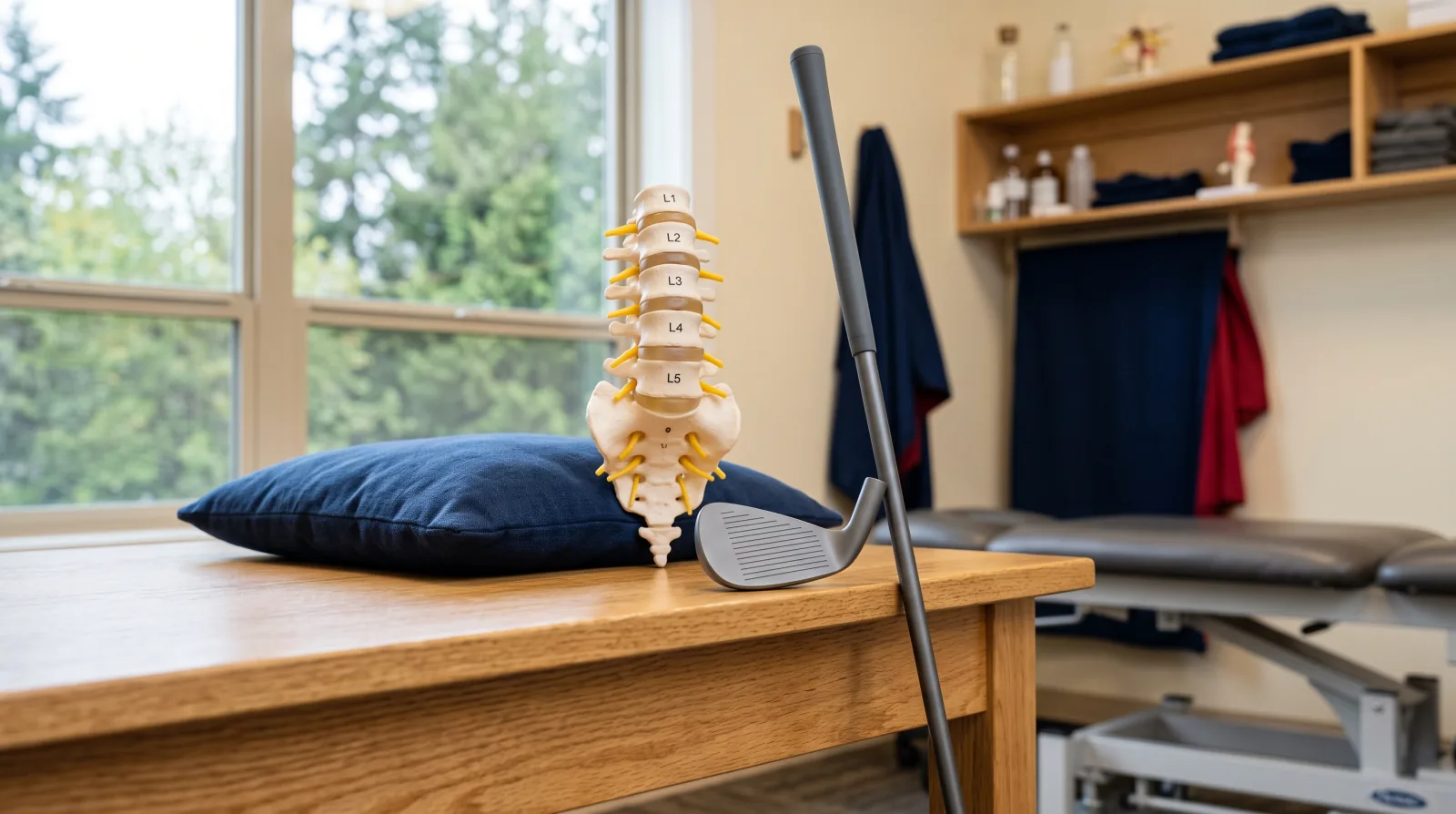
The Golf Swing and Low Back Pain: Why the Lower Back Takes the Load
The low back does more work in a golf swing than most players realize. Here is what the swing asks of the lumbar spine, and why load management beats a quick stretch.
BY AMIR AHMADI, PHD
A golf swing looks smooth from the tee box, but the lower back is doing more work in that two-second motion than almost any other joint in the body. The lumbar spine is consistently the most commonly injured area in golf, in weekend players and touring professionals alike.
At Medstar Sport Physio in North Vancouver, we see golf-related low back pain most often in players whose hip rotation or trunk strength cannot keep up with the rotation and side-bending their swing demands, and the fix is usually a combined program of hip mobility, rotational strength, and managed swing volume rather than a single stretch or a quick technique fix. The research on which exact swing metric causes the pain, such as the X-factor or the crunch factor, is still mixed, so assessment focuses on what your specific back and hips can and cannot do.
Why the low back carries so much of the load
The golf swing is a whole-body rotational movement, but the lumbar spine sits at the center of the chain that connects the lower body's rotation to the upper body's. A review of biomechanical risk factors for low back pain in golf describes the lower back as the most frequently injured area in both amateur and professional golfers, though the two groups tend to get there differently. Professionals accumulate load through high practice and competition volume with relatively little swing variability, repeating the same pattern thousands of times a season. Amateurs more often combine inconsistent technique with underlying strength or mobility limits that the swing exposes.
The swing itself produces real compressive force through the spine. The same review reports lumbar compressive loads reaching roughly 6.5 to more than 8 times body weight immediately after impact, concentrated in a fraction of a second as the club meets the ball. That is not a reason to fear the movement, since the spine is built to tolerate repeated loading when it has the capacity to do so. It does explain why a back with limited rotation or weak supporting muscles struggles more than one that has been conditioned for the demand.
The X-factor: more speed, more debate
Golf instruction has spent years chasing the X-factor, the difference in rotation between the shoulders and the hips at the top of the backswing. A bigger separation stores more rotational energy and is associated with faster clubhead speed, which is why coaches often cue players to increase it.
The concern for the lower back is what happens during the transition, sometimes called the X-factor stretch, when the hips start rotating toward the target while the shoulders are still turned back. That creates a rapid increase in trunk-to-hip separation right as the downswing begins, and some research has proposed this adds meaningful shear load to the lower lumbar segments, particularly around L4-L5 and L5-S1.
The honest caveat, drawn from the same 2024 systematic review searches on golf swing biomechanics and back pain, is that the evidence tying a specific X-factor value to injury risk is limited and inconsistent across studies. A large X-factor is not automatically dangerous, and a small one does not guarantee safety. It is one plausible contributor among several, which is why we do not build a golf back-pain assessment around a single number.
The crunch factor: a plausible idea that has not held up cleanly
A second concept worth knowing is the crunch factor, which combines lateral bending (side-bending) of the lumbar spine with its rotation during the downswing. It was proposed as a mechanism for wear and degeneration at the lower lumbar facet joints, since combined bending and twisting is a loading pattern the spine tolerates less well than either movement alone.
Later studies that measured this differently have reported a lack of repeatability for the crunch factor as a predictor of low back pain, and some found no clear difference between golfers with and without a history of back pain. That does not mean side-bending and rotation are irrelevant to the lower back. It means the crunch factor, as a single measurable number, has not proven itself as a reliable red flag on its own.
Where hip mobility actually fits in
The factor that shows up consistently in clinic is hip rotation, particularly in the lead hip (the left hip for a right-handed golfer). The pelvis needs to rotate through the downswing ahead of the trunk to sequence the swing efficiently. When the lead hip cannot rotate internally through that range, the body still needs to generate the same total rotation to hit the ball, and the lower back is a common place for that shortfall to be made up.
This is a straightforward thing to screen. We check hip internal and external rotation on both sides, compare it to what a full swing needs, and look at how a limited hip changes the swing pattern, often showing up as early extension, a term golf coaches use for the hips and spine straightening up too early in the downswing rather than staying rotated. A physiotherapist and a swing coach are looking at the same fault from two different angles, and addressing both tends to work better than either alone.
Building capacity instead of chasing a stretch
A common instinct is to stretch the lower back before playing and hope that solves it. Stretching has a place in a warm-up, and a review of golf-related low back pain and prevention strategies lists specific strengthening exercises for the trunk and hip, including bridges, planks, bird dogs, and rotational core work, as part of prevention. The emphasis on strength and rotation control, not flexibility alone, matters. A back that is loose but weak does not necessarily tolerate the swing better; a back with the rotation, strength, and hip mobility to share the load usually does.
In our clinic, a golf-specific back program builds lumbar and hip rotation to the range the swing requires, trunk and hip strength to control that range under load, and a gradual return to full swing volume rather than an abrupt jump from rehab straight back to 18 holes. Someone dealing with more general low back pain unrelated to sport follows a similar logic: restore the movement, build the strength around it, then reintroduce the specific demand.
Managing volume while the back rebuilds
Total rest is rarely the right answer for golf-related back pain. Time away lowers the back's tolerance to rotational load, so a golfer who stops entirely for six weeks often returns to the same pain on the first range session, because the tissue that needs to handle the swing has become less capable, not more.
A more useful approach reduces swing volume and intensity to a level the back tolerates, while the rehab program builds capacity underneath it. That might mean starting with putting and chipping, adding half-swings with shorter clubs, and building toward full-swing driver work as symptoms and strength allow. The plan is adjusted by how the back responds the next day, not by a generic weekly schedule.
When to get it looked at
Most golf-related low back pain is a load and mobility problem that responds to the kind of program described here. Some patterns need medical attention rather than a physiotherapy booking: pain following a specific twisting injury with sudden severe onset, numbness or tingling down a leg, weakness in the leg, or any loss of bladder or bowel control. Those features warrant prompt assessment by a physician or, for the more serious combination of leg weakness with bladder or bowel changes, urgent care.
If your back tightens up during a round or the day after, and it has been a repeating pattern rather than a one-off, an assessment sorts out whether the driver is hip mobility, trunk strength, swing mechanics, or some combination, and builds a plan around your specific swing and your specific back.
Book a 30-minute assessment and we will check your rotation, your hip mobility, and your trunk strength, and set a return-to-golf plan that respects how your back is actually responding rather than a one-size-fits-all stretching routine. You can also read about our active rehab approach or see what we treat.
This article is general information about golf-related low back pain. It is not personal medical advice. A regulated practitioner can confirm whether the patterns described apply to you.
Sources
- Low back pain and golf: A review of biomechanical risk factors (PMC, 2021)
- Golf-Related Low Back Pain: A Review of Causative Factors and Prevention Strategies (Asian Journal of Sports Medicine)
- College of Physical Therapists of BC (CPTBC)
Common questions
Frequently asked questions.
Why do golfers get low back pain so often?
The lower back is consistently reported as the most common injury site in golf, in both amateur and professional players. The golf swing combines spinal rotation, side-bending, and a fast change of direction from backswing to downswing, and it repeats that pattern hundreds of times in a round or a practice session. A back that lacks the rotation, strength, or hip mobility to share that load ends up absorbing more of it than it can comfortably manage.
What is the X-factor, and does it cause back pain?+
The X-factor is the difference in rotation between the shoulders and the hips at the top of the backswing. A larger separation is linked to more clubhead speed, which is why many players are coached to increase it. Some research has raised concern that a large X-factor stretch during the transition into the downswing adds shear load to the lower lumbar segments, though the evidence connecting a specific X-factor number to injury risk is mixed rather than settled.
Is the 'crunch factor' a proven cause of golf back pain?+
Not conclusively. The crunch factor describes the combination of side-bending and rotation at the lumbar spine during the downswing, and it was proposed as a driver of wear at the lower lumbar joints. Later studies measuring it different ways have not consistently found a difference between golfers with and without back pain, so it is one plausible factor among several rather than a confirmed single cause.
Does hip mobility affect back pain in golfers?+
It can. The lead hip needs to rotate internally through the downswing so the pelvis can turn ahead of the trunk. When that hip mobility is limited, the body tends to make up the rotation somewhere else, and the lower back is a common place for that compensation to land. Assessing hip rotation is a standard part of a golf-related back assessment for this reason.
Should I stop playing golf if my back hurts?+
Usually not completely. Total rest lowers the back's tolerance to the loads a swing produces, so returning at full volume after a long break often triggers the same pain again. Most golfers do better modifying volume and swing intensity while the back rebuilds capacity, guided by how symptoms respond, rather than stopping entirely and restarting cold.
Can changing my swing technique fix golf back pain?+
Sometimes, but not always, and not on its own. A swing coach can address technical patterns like early extension or excessive lateral bend, and that can help. Technique change works best paired with physiotherapy addressing strength, rotation, and hip mobility, since a swing fault is often the visible result of a physical limitation rather than a habit that will correct itself with cueing alone.
What does a physiotherapy assessment for golf back pain look like?+
The physiotherapist screens for red flags, then checks lumbar rotation, extension, and side-bending, hip internal and external rotation on both sides, and core and hip strength. We ask about your swing, your typical round volume, and when the pain shows up, at address, at the top of the backswing, through impact, or afterward, since the timing points toward different structures.
How long does it take to get back to a full round pain-free?+
Recovery timelines depend on the tissue involved, how long the pain has been present, and how quickly you rebuild rotation, strength, and swing tolerance. It is reasonable to expect a staged return, starting with putting and short irons before full driver swings, rather than a fixed number of weeks that applies to everyone.
Share this post
Copies a ready-to-publish LinkedIn post to your clipboard and opens the LinkedIn share dialog. Paste the text into the composer and publish.

Written by
Amir Ahmadi, PhDDr. Amir Ahmadi is a Registered Physiotherapist, Certified IMS Therapist and former Associate Professor. 20+ years of clinical practice in North Vancouver.
This article is for general information only and does not constitute medical advice, diagnosis, or treatment. Individual presentations vary, and assessment findings and treatment plans differ from person to person. If you are experiencing severe symptoms, neurological changes (numbness, weakness, bowel or bladder changes), or a significant trauma, contact your physician or emergency services. Care at Medstar Sport Physio & Health is provided by practitioners registered with their respective British Columbia regulatory colleges.
Filed under
- golf
- low-back-pain
- biomechanics
- load-management
- north-vancouver


