TECAR / CRet
TECAR Therapy — North Vancouver
Deep endogenous heat generated inside the muscle and joint — not heated from the surface. The only TECAR therapy on the North Shore.
What it is
TECAR Therapy — North Vancouver at Medstar.
TECAR Therapy — formally Capacitive and Resistive Energy Transfer, or CRet — uses radiofrequency current at around 500 kHz to generate controlled deep heat inside muscle, tendon, ligament, and joint tissue. Unlike ultrasound (which heats surface tissue and is mostly mechanical) or hot packs (which heat from outside in), TECAR generates heat endogenously — the patient's own tissue becomes the heat source.
Medstar Sport Physio is the only physiotherapy clinic on the North Shore to offer TECAR. The technology originated in European sports medicine and is now used routinely by professional football, cycling, and tennis teams — Real Madrid, FC Barcelona, the ATP tour — to accelerate recovery between sessions and shorten return-to-play timelines after acute injury.
Inside the clinic, TECAR sits alongside manual therapy and exercise in the same physiotherapy hour. It's a tissue-prep tool: the deep warming relaxes muscle guarding, increases local circulation, and makes joints more responsive to the mobilisation and loading work that comes next. Sessions also reduce post-treatment muscle soreness in a way that lets patients tolerate heavier rehab progressions sooner.
How it works
Inside a session.
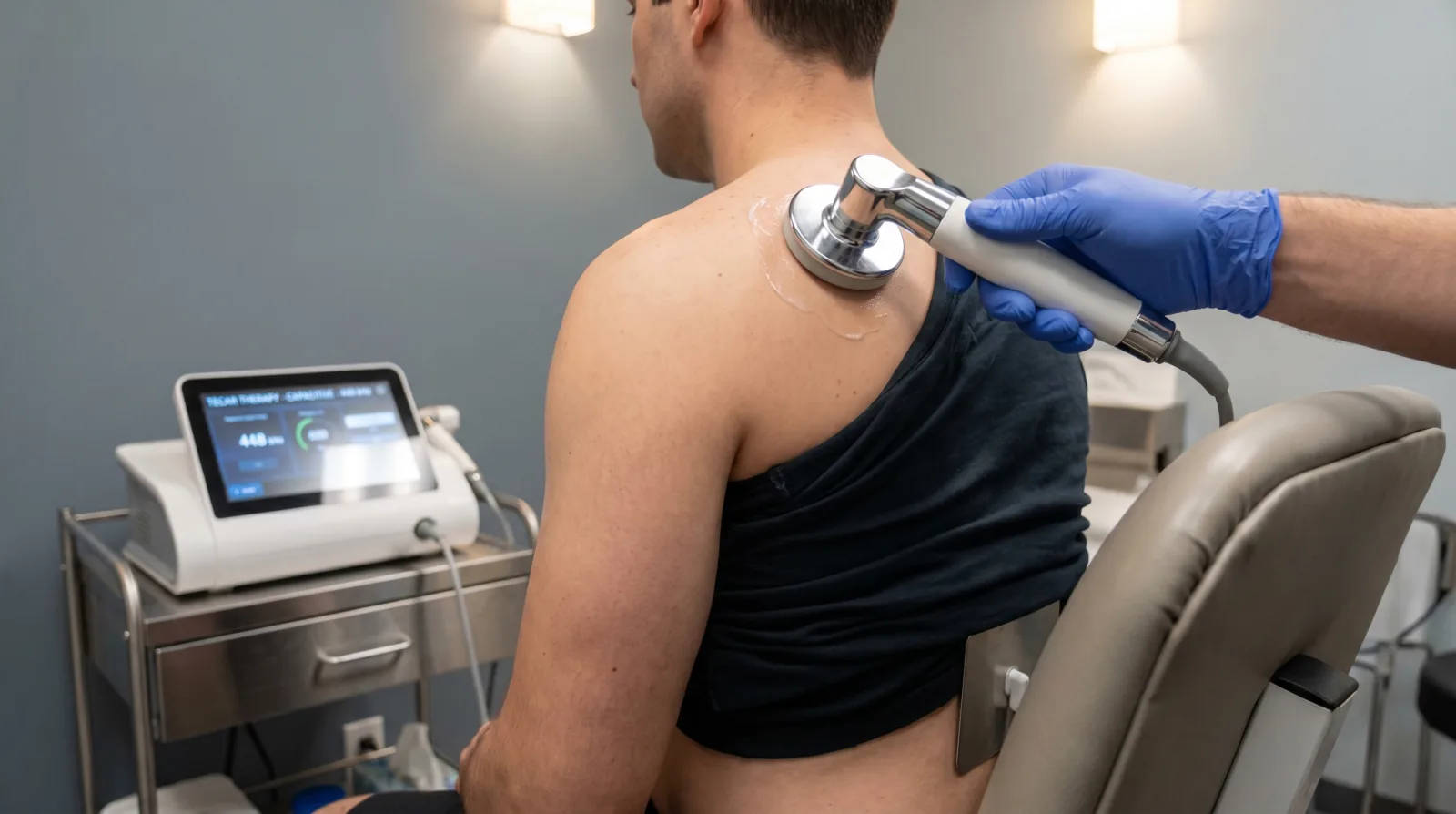
A TECAR-inclusive visit starts with a brief reassessment of the target tissue. The physiotherapist applies a thin layer of conductive cream to the skin and selects between capacitive mode (smaller electrode, surface and intermediate-depth tissue) or resistive mode (larger electrode, deepest tissue and bony structures). A flat return electrode plate sits on the opposite side of the body region to complete the circuit.
The handpiece is then moved continuously across the treatment area — never held stationary — for 8–15 minutes. The sensation is a deep, pleasant warmth that builds over the first minute and stays well within comfort range. Most patients describe it as relaxing. If the warmth crosses the comfort threshold, the operator immediately lowers the radiofrequency power.
Treatment is followed by the manual therapy and exercise prescription the case actually needs — TECAR is the warm-up that lets the rest of the session work harder. We don't run TECAR-only treatment series; that's not where the value lives.
Conditions we treat with this
See how tecar therapy fits into specific recovery plans.
- Low back pain & sciatica — chronic muscular guarding
- Shoulder & rotator cuff — frozen shoulder stiffness phase
- Knee injury & ACL recovery — post-op stiffness
- Hip pain & groin injuries — chronic OA management
- Ankle & Achilles injuries — chronic tendinopathy pre-loading
- Whiplash — chronic post-collision muscle guarding
What to expect
Most patients feel a clear difference in muscle tone and joint range during the session itself — the manual therapy and exercise that follow are visibly easier to deliver. Sustained benefit across a treatment course builds over 6–10 visits, with TECAR delivered as part of every physiotherapy visit through the most active phase of rehab.
Talk to us
Not sure if it's the right fit?
Send a quick note about what's going on. A physiotherapist will read it and tell you honestly whether tecar therapy is the right tool — or whether something else makes more sense first.
Common questions
About tecar therapy.
How is TECAR different from ultrasound or a heat pack?+
Heat packs warm the skin from the outside; the heat barely penetrates past the subcutaneous fat. Ultrasound delivers low-intensity mechanical vibration that produces mild surface heat — its evidence base for deep musculoskeletal effect is weak. TECAR uses radiofrequency current at around 500 kHz to make the tissue itself become the heat source, reaching depths that hot packs and ultrasound cannot. The therapeutic effect is fundamentally different — you can feel it through the entire muscle belly, not just the skin surface.
Does TECAR hurt?+
No. The dominant sensation is a deep, pleasant warmth — most patients describe it as relaxing. There is no sharp or burning sensation when the device is used correctly; if the warmth crosses the comfort threshold, the operator immediately reduces the radiofrequency power. Comfort during treatment is the standard, not the exception.
Are there side effects?+
Side effects are rare and minor — occasionally a transient skin flush at the treatment site that resolves within an hour. Contraindications include pregnancy (over the abdomen, pelvis, and low back), pacemakers and implanted electronic devices, active malignancy in the treatment area, severe arterial circulation problems, and treatment over open growth plates in children. Tell your physiotherapist about all implants and medical history before the first session.
How does TECAR compare to shockwave or laser therapy?+
Different mechanisms, different best uses. TECAR delivers controlled deep heat to prepare tissue for manual therapy and loading — it's a session-enhancer, not a standalone series. Shockwave delivers high-energy mechanical pulses that mechanically disrupt stuck chronic tendinopathy — used in 3–6 standalone sessions for specific tendon problems. Class IV laser modulates inflammation at the cellular level — used in 6–10 sessions for acute injury and post-op recovery. We pick the right tool for the case; sometimes TECAR plus laser, sometimes TECAR plus loading alone.
Is TECAR covered by ICBC or extended health?+
TECAR is delivered as part of your physiotherapy appointment, not as a separate service line. It's billed as physiotherapy on your receipt and direct-billed through extended-health insurers, ICBC, and WorkSafeBC the same way any physio visit would be. There is no separate TECAR charge.
How many sessions before I notice a difference?+
Most patients feel a clear shift in muscle tone, joint range, and discomfort during the first TECAR-inclusive visit. Sustained benefit across the rehab arc builds over the typical 6–10 visit physiotherapy course. If you've had three TECAR-inclusive sessions and the case isn't moving, that's the conversation we have at visit four — we adjust the plan rather than keep adding treatments.
Can I do TECAR on its own, without other physiotherapy?+
No — and we wouldn't recommend it. TECAR is a tool inside a physiotherapy plan: it makes the manual therapy and loading work harder and more comfortable. Without those follow-on interventions, the change you feel during the session doesn't last. We don't offer standalone TECAR appointments.
This page is for general information only and does not constitute medical advice, diagnosis, or treatment. Treatment suitability is determined case-by-case during assessment; not every service is appropriate for every presentation. If you have a medical implant, are pregnant, take blood thinners, or have an active infection, tell your physiotherapist before treatment. Physiotherapy at Medstar Sport Physio & Health is provided by physiotherapists registered with the College of Physical Therapists of British Columbia (CPTBC).
Ready to book?