Shockwave Therapy for Plantar Fasciitis: When It Helps and When It Doesn't
Shockwave is one of the better-supported modalities for stubborn plantar fasciitis, but it is not a first-line treatment and it is not a fix for everyone. Here is when we use it at Medstar, and the cases where we don't.
BY AMIR AHMADI, PHD
Extracorporeal shockwave therapy is one of the better-supported physiotherapy treatments for plantar fasciitis that has not improved after 4 to 8 weeks of loading and stretching. It is not a first-line treatment and does not replace a rehab program. At Medstar Sport Physio in North Vancouver, we use it as a second-line tool for chronic cases, typically three to five weekly sessions paired with a graded loading program. The proposed mechanism involves increased microcirculation and a low-grade tissue reset rather than "breaking up" anything. Whether shockwave is appropriate depends on how long symptoms have been present, whether a proper loading program has already been tried, and whether the diagnosis is actually plantar fasciitis.
If you have been dealing with that classic first-step-in-the-morning heel pain for months, you have probably been offered shockwave at some point. The reason it keeps coming up in clinical conversations is that the evidence behind it is genuinely stronger than for most passive modalities. The reason we still hold it back as a second-line tool is that the cases where it adds value are narrower than the marketing usually suggests.
What shockwave actually does to plantar fascia tissue
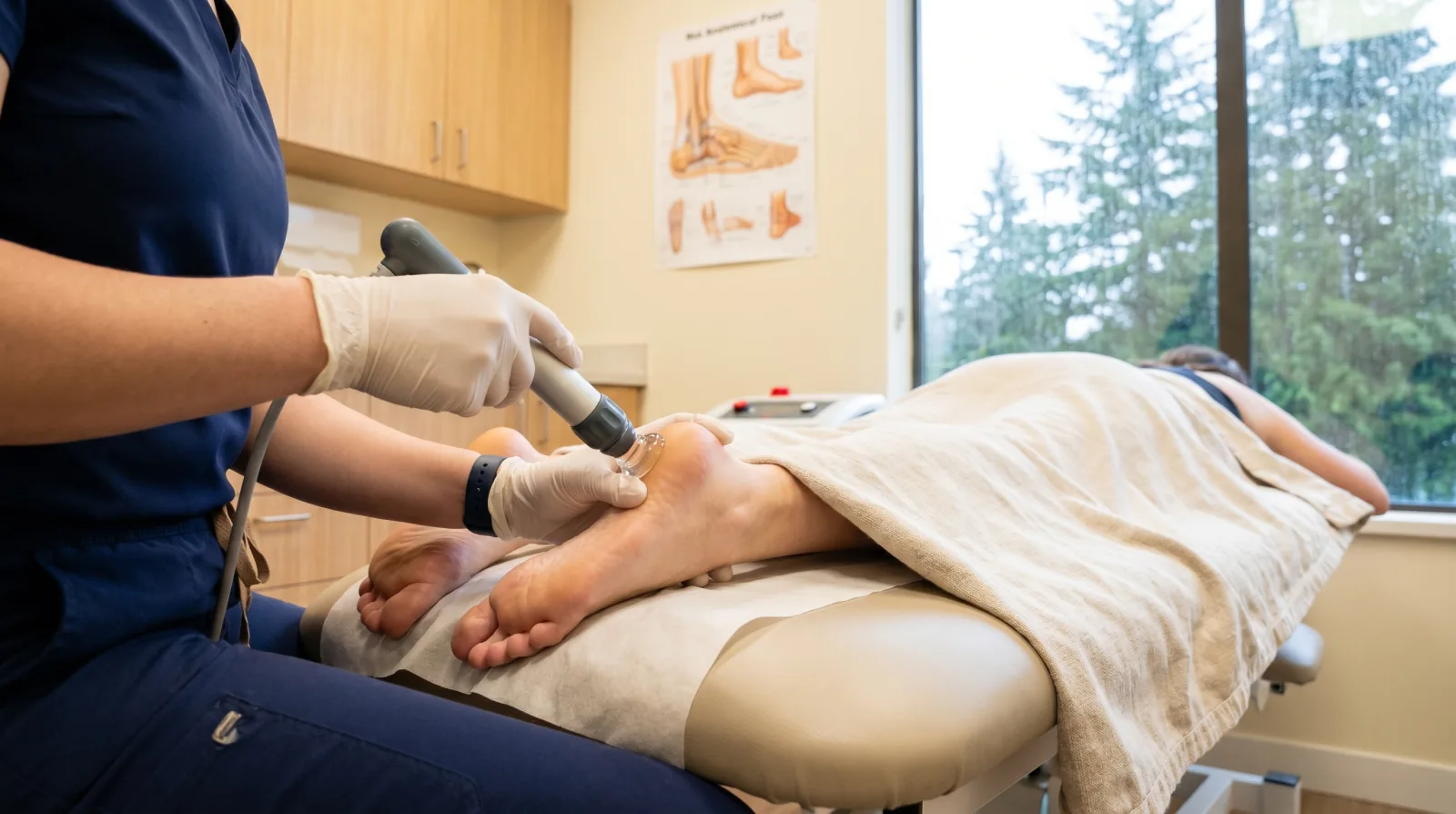
Extracorporeal shockwave therapy delivers acoustic pressure pulses through a handpiece pressed against the skin. Two delivery types are in clinical use. Radial shockwave is the more common form in physiotherapy clinics, where a pneumatically-driven handpiece spreads energy across a broader, shallower area. Focused shockwave concentrates energy at a deeper, more precise point and is typically delivered with a piezoelectric or electrohydraulic device. Both are described in the International Society for Medical Shockwave Treatment's overview of shockwave technologies.
The "breaking up tissue" framing is closer to a sales pitch than to physiology. Current reviews describe shockwave as a localised mechanical stimulus that promotes a controlled tissue response: increased microcirculation in the treated area, modulation of pain signalling at the local nerve endings, and a low-grade inflammatory reset that nudges the tendon or fascia back into a productive remodelling phase. The full mechanism is still being worked out in the literature. What is more settled is that shockwave can produce clinically meaningful symptom and function changes in chronic, recalcitrant plantar fasciitis, especially when paired with a loading program.
When shockwave is genuinely useful for plantar fasciitis
The cases where shockwave earns its place in the plan share a pattern: the symptoms have been around long enough that the tissue is no longer in an acute inflammatory phase, and a competent rehab program has been tried and stalled.
We consider shockwave in three patterns:
- Plantar fasciitis with symptoms longer than three months, where the morning pain on first steps is the dominant complaint and where calf stretching, plantar fascia stretching, and a graded loading program have produced only partial improvement.
- Insertional plantar fasciopathy where the painful spot is at the medial calcaneal tubercle and palpates as a discrete, stubborn focal area.
- Cases where the patient has had a corticosteroid injection that produced short-term relief but the pain returned. Shockwave is one of the better tolerated next steps in that scenario.
A 2024 network meta-analysis in JBJS Reviews compared common conservative treatments for plantar fasciitis and concluded that extracorporeal shockwave therapy ranked among the more effective interventions for chronic cases when measured against placebo and against several other modalities at three to six months. Effect sizes for chronic plantar fasciitis are typically in the moderate range, which is a real but modest benefit. The same reviews note that the benefit is most reliable when shockwave is combined with active exercise.
When shockwave is the wrong call
Shockwave is contraindicated or unnecessary in several situations we see weekly. In our clinic the most common reasons we hold off:
- The pain is acute, with onset within the last two to four weeks. Acute plantar fasciitis usually responds to relative rest, footwear changes, and a basic loading and stretching program. Adding shockwave in that window is overtreatment.
- The diagnosis is not actually plantar fasciitis. Heel spur and other heel pain sources can be a fat pad contusion, tarsal tunnel syndrome, calcaneal stress reaction, or S1 nerve root referral. None of those respond to shockwave the way fasciopathy does. A proper differential is the gate.
- The patient is on anticoagulants, has a coagulation disorder, has a local infection or open wound at the treatment site, is pregnant (treatment over the abdomen or lumbar spine), or has a malignancy at the target tissue. These are standard shockwave contraindications and are detailed on the ISMST safety statement.
- The patient has not tried a structured loading program yet. Shockwave without rehab usually just buys a temporary symptom dip.
What a shockwave course at Medstar looks like
A typical plantar fasciitis course runs three to five weekly sessions of radial shockwave, each session about 15 to 20 minutes of treatment inside a 30-minute physiotherapy visit. The first session is usually a few intensity levels lower than the subsequent ones, because we want to map the patient's pressure tolerance before we push it.
We pair every session with progressions on the loading program. The exercise the patient is doing at home matters more than the device. Heavy slow-resistance loading of the plantar fascia and calf complex, described in the Rathleff et al. high-load strength training protocol published in the Scandinavian Journal of Medicine and Science in Sports, has produced some of the better long-term outcomes in the plantar fasciitis literature. Shockwave is the modality that lets the tissue tolerate the loading; the loading is what actually changes the tissue's tolerance over time.
We reassess at the third session. If the morning first-step pain has not moved, if pressure pain on the medial calcaneal tubercle has not changed, and if the loading program has been done consistently, that is our signal to step back and rethink, not to push through another two sessions.
Realistic expectations on the timeline
Most patients describe a noticeable change between sessions two and four. The morning pain tends to soften first; the after-activity pain takes longer. Full resolution of a chronic plantar fasciitis case rarely happens in the four weeks of the shockwave course alone. Twelve to sixteen weeks of combined shockwave plus loading is a more realistic window for the kind of plantar fasciitis that has been around for more than six months.
A small portion of patients respond strongly and early. A roughly equal portion respond partially, with the symptoms dropping from a six out of ten morning pain to a two without fully resolving. A small subset do not respond at all. That last group is where the diagnosis usually needs a second look, often with imaging via the family physician.
Where shockwave sits in the broader plantar fasciitis hierarchy
For plantar fasciitis under three months of symptoms, the first move is load management and a basic exercise and stretching program. Most cases resolve there without any modality at all. For symptoms beyond three months that are not responding to a competent program, shockwave is one of the better-evidenced next steps, alongside custom orthotics where the foot mechanics warrant them. Corticosteroid injection produces faster short-term relief but carries a known risk of fascia rupture with repeated injections. See the American College of Foot and Ankle Surgeons clinical practice guideline on heel pain for the full hierarchy. Surgery is rare and reserved for truly recalcitrant cases.
Shockwave is the modality we reach for when the patient is doing the right rehab and the tissue still will not budge. It is not the headliner; it is the part of the plan that often lets the rest of the plan work.
This article is general information about extracorporeal shockwave therapy for plantar fasciitis. It is not personal medical advice. A regulated practitioner can confirm whether the patterns described apply to you.
Sources
- International Society for Medical Shockwave Treatment: about ESWT
- International Society for Medical Shockwave Treatment: clinical recommendations and contraindications
- Sun et al. network meta-analysis on conservative treatments for plantar fasciitis, JBJS Reviews (2024)
- Rathleff et al., High-load strength training improves outcome in patients with plantar fasciitis, Scandinavian Journal of Medicine and Science in Sports
- American College of Foot and Ankle Surgeons: clinical practice guidelines and consensus statements
- College of Physical Therapists of BC (CPTBC)
Common questions
Frequently asked questions.
Is shockwave therapy painful?
Most patients describe radial shockwave on the plantar fascia as moderately uncomfortable rather than painful. The intensity is dialled to a level that is tolerable for the patient and effective for the tissue. Focused shockwave can feel sharper at the focal point. Discomfort settles quickly after the session and is not the same as the tissue irritation that triggers a real pain flare.
How many shockwave sessions does plantar fasciitis usually need?+
A typical plantar fasciitis course at Medstar runs three to five weekly shockwave sessions, each about 15 to 20 minutes of treatment inside a 30-minute physiotherapy visit. Most patients describe a noticeable change between sessions two and four, with the morning first-step pain tending to soften before the after-activity pain does. We reassess at the third session. If the morning pain and the pressure tenderness have not moved, we revisit the diagnosis rather than push through more sessions.
Can I run between shockwave sessions?+
Light running is usually fine if it does not aggravate the morning pain pattern. We coach a step-back rather than a full stop, because the rehab exercises only work if the tissue is being loaded. We adjust mileage based on next-morning symptoms, not on a fixed rule.
Does extended health insurance cover shockwave?+
Shockwave is delivered inside a physiotherapy session in BC, so it is generally billed as a physiotherapy visit and follows your physiotherapy benefit. Some plans single out modalities differently. Check your specific plan or call the clinic if you want us to verify before booking.
What if shockwave doesn't work for my heel pain?+
If a full course produces no change, the next step is usually a re-examination. The diagnosis may be off, or the loading program may need adjustment before the modality can do its job. We will also discuss whether imaging, a custom orthotic, or referral to a foot specialist makes sense.
What happens at a first physio visit if I am being considered for shockwave?+
The physiotherapist confirms the diagnosis first, since heel pain can come from a fat pad contusion, tarsal tunnel syndrome, or a calcaneal stress reaction rather than true plantar fasciitis. They also check whether a structured loading program has genuinely been tried, since shockwave without rehab usually only produces a temporary symptom dip. Shockwave is added once those two things are clear.
Is shockwave the same as the TECAR therapy Medstar offers?+
No. Shockwave delivers acoustic pressure pulses through a handpiece, aiming for a mechanical stimulus and a low-grade tissue reset. TECAR uses capacitive or resistive energy transfer, a different mechanism, for a different range of soft-tissue presentations. Your physiotherapist chooses the modality based on the tissue and the stage of the condition, not by treating them as interchangeable.
Can I do the shockwave loading exercises at home between sessions?+
Yes, and doing so is part of what makes the course work. The exercise program, particularly heavy slow-resistance loading of the plantar fascia and calf, is what changes the tissue's tolerance over time, while shockwave helps the tissue tolerate that loading. We adjust the home program at each session based on how the foot has responded.
Share this post
Copies a ready-to-publish LinkedIn post to your clipboard and opens the LinkedIn share dialog. Paste the text into the composer and publish.

Written by
Amir Ahmadi, PhDDr. Amir Ahmadi is a Registered Physiotherapist, Certified IMS Therapist and former Associate Professor. 20+ years of clinical practice in North Vancouver.
This article is for general information only and does not constitute medical advice, diagnosis, or treatment. Individual presentations vary, and assessment findings and treatment plans differ from person to person. If you are experiencing severe symptoms, neurological changes (numbness, weakness, bowel or bladder changes), or a significant trauma, contact your physician or emergency services. Care at Medstar Sport Physio & Health is provided by practitioners registered with their respective British Columbia regulatory colleges.
Filed under
- shockwave
- plantar-fasciitis
- heel-pain
- north-vancouver
- tendinopathy