TECAR Therapy for Tendinopathy: What the Modality Actually Does
TECAR is one of the newer adjunct modalities in tendinopathy care. The mechanism is real, the evidence is early, and the role is supportive alongside the loading work.
BY AMIR AHMADI, PHD
TECAR therapy uses radiofrequency energy to generate tissue-deep heat and a low-grade bioelectric stimulus that can reduce pain and improve a tendon's tolerance to loading. The device operates in two modes: capacitive mode for more superficial tissue, and resistive mode for denser structures like tendon. The evidence for TECAR in tendinopathy is real but early, showing short-term improvements in pain and function when added to a loading program. The benefit tends to be most visible in the first few weeks of treatment; longer-term outcomes are similar to exercise alone. At Medstar Sport Physio in North Vancouver, TECAR is used as an adjunct to help patients complete useful loading earlier in rehab, not as a standalone treatment. The loading program remains the active ingredient. Whether TECAR is appropriate for your tendinopathy depends on the stage and irritability of the tendon.
If your clinician has offered TECAR for an Achilles, patellar, gluteal, or proximal hamstring tendinopathy, this is the version of the conversation we have at the first visit.
What TECAR actually is
TECAR is a radiofrequency electrotherapy modality that delivers energy in the high-radiofrequency range. Most clinical devices operate around 400 to 500 kHz, well below the megahertz range of medical diathermy. The device uses two operating modes:
- Capacitive mode targets softer, water-rich tissues. Energy concentrates in the more superficial layers: skin, subcutaneous fat, and superficial muscle. We use capacitive mode for surface-level pain modulation and for mobilising the fascia overlying the tendon.
- Resistive mode targets denser, more electrically-resistant tissue such as tendon, bone, and deep myofascial junctions. The energy concentrates deeper in the tissue layers, which is where most of the tendinopathy work happens.
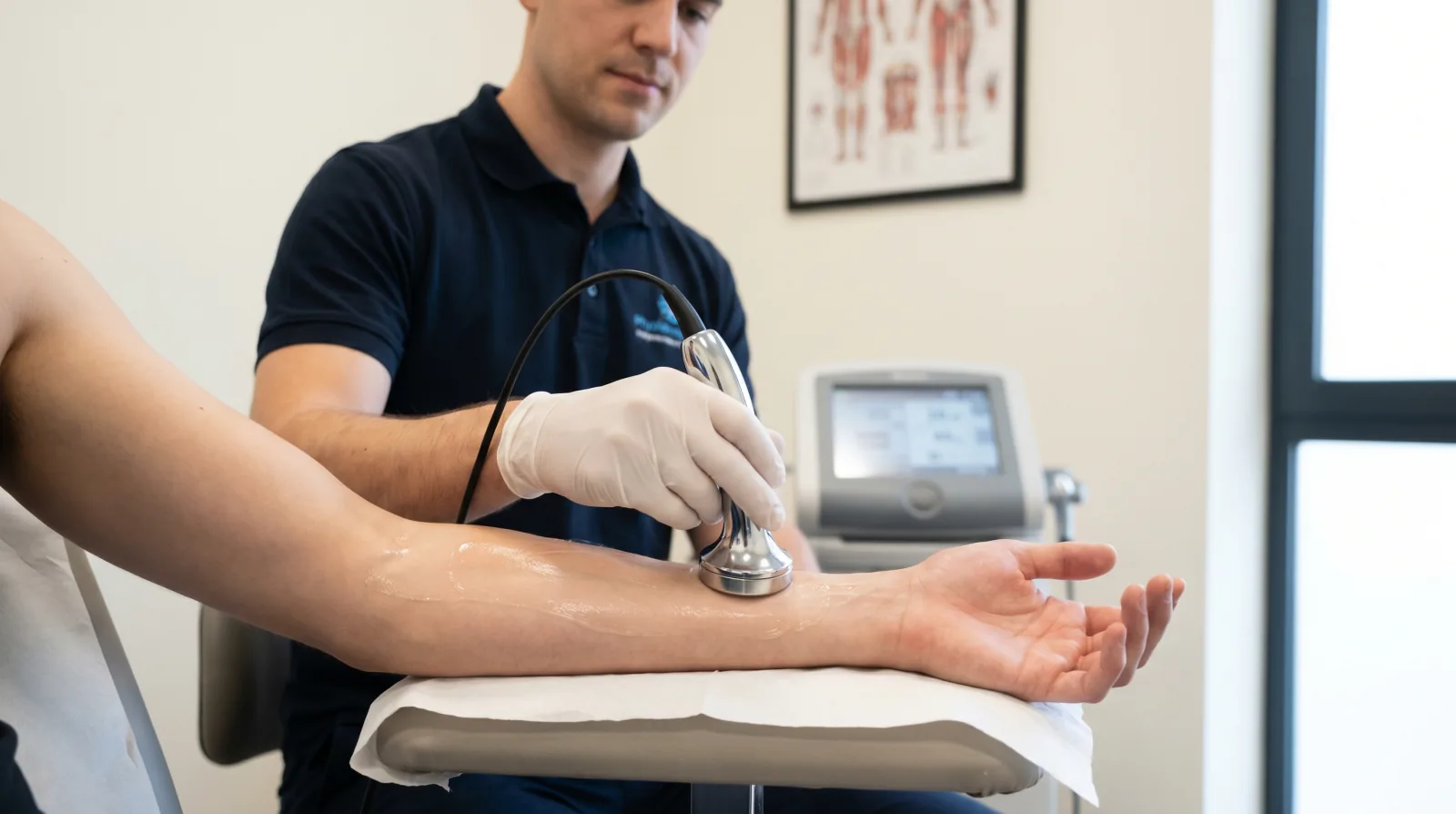
The practitioner moves a rounded metallic handpiece in slow circular patterns across the treatment area, with a conductive cream as the coupling agent. A grounding plate completes the circuit. The patient feels a deep, even warming sensation. A typical TECAR component of a session runs 10 to 15 minutes inside a 30 or 60-minute physiotherapy visit.
What it does to tendinopathic tissue
The proposed mechanisms, summarised in the European Journal of Translational Myology overview of capacitive and resistive electric transfer, include localised hyperaemia, an increase in tissue temperature that stays in a physiologically safe range, and a low-grade bioelectric stimulus that may influence cellular activity at the treatment site. None of those mechanisms are unique to TECAR, since heat, increased circulation, and mechanical input can be produced by other means. What is different about TECAR is the combination delivered into deep tissue without surface heating that has to pass through skin first.
In tendinopathy specifically, the working clinical model is that TECAR temporarily reduces pain and improves tissue tolerance, which lets the patient complete the loading exercises that drive the actual tissue remodelling. The loading is the active ingredient. TECAR is the modulator that makes the loading possible at a useful intensity earlier in the rehab.
What the evidence supports, and what it does not
The TECAR evidence base in tendinopathy is real but smaller than the marketing materials suggest. A handful of randomised trials and a 2022 systematic review have evaluated capacitive and resistive electric transfer in lateral epicondylalgia, patellar tendinopathy, and Achilles tendinopathy.
The pattern that emerges from those studies is consistent. TECAR added to a competent active-rehab program produces short-term improvements in pain and function compared with exercise alone or sham. The added benefit tends to be most visible in the first four to six weeks. Long-term outcomes converge. By three to six months, the gap between TECAR-plus-exercise and exercise-alone narrows considerably.
What that means for the patient: TECAR can shorten the early painful window where loading feels intolerable. It does not produce a better tendon at the end of the rehab compared with what good loading alone can produce. The clinical value sits in the early weeks, not the endgame.
For a balanced sense of where loading sits in tendinopathy rehab, the Beyer et al. heavy slow resistance vs. eccentric training in Achilles tendinopathy trial is a useful anchor. Heavy slow-resistance training produced durable improvements in both symptoms and tendon structure at twelve months. Modalities are adjuncts to that work, not substitutes.
When TECAR earns its place in our plan
We use TECAR when the patient has a tendinopathy that meets a few criteria:
- The diagnosis is clear, with load-related tendon pain reproduced on a standardised loading test (single-leg heel raise for Achilles, single-leg decline squat for patellar, hip abduction in side lying for gluteal).
- The symptoms are interfering with the patient's ability to complete the prescribed loading program at the intensity that produces change.
- The patient has been loading consistently for two weeks or more and the early painful window has not yet softened.
- Other adjuncts (taping, footwear adjustment, a brief load deload) have not closed the gap.
Common cases at Medstar where TECAR shows up in the plan:
- North Shore trail runner with mid-portion Achilles tendinopathy who needs to keep loading to hold their season but cannot tolerate the planned calf raises without pain modulation.
- Rec basketball or volleyball player with patellar tendinopathy in the early weeks of a heavy slow-resistance program, where the deep tendon discomfort is making the loading sets feel disproportionate.
- Female runner with gluteal tendinopathy and lateral hip pain on side lying. TECAR is paired with hip-abduction loading and sleep position coaching.
When TECAR is not the right call
Several patterns push us toward other tools:
- Recalcitrant tendinopathy beyond six months of failed conservative care. The literature on shockwave therapy is stronger in that population, so we usually shift to shockwave or refer for orthopaedic consultation.
- Tendinopathy with a clear biomechanical driver that the patient has not addressed (wrong shoe, novel mileage spike, training error). The right move is to fix the input, not add a modality.
- Acute tendon rupture or partial-thickness tear with significant structural change on imaging. That is a different rehab pathway entirely.
- The contraindications listed in the FAQ above.
Where TECAR fits in the full tendinopathy plan
A realistic tendinopathy course in our clinic looks like this:
- Weeks 1 to 4. Heavy slow-resistance loading three days a week. Pain monitor on the next-morning symptom and the loading test response. TECAR twice a week if the loading is not yet tolerable. Education on the timeline.
- Weeks 5 to 8. Loading progresses. TECAR tapers to once a week, then drops out as the patient tolerates the loading without modality support. Reassessment against function.
- Weeks 9 to 12. Loading continues at higher intensity or moves toward sport-specific patterns. Modality use is rare in this phase.
- Beyond 12 weeks. If symptoms have not changed, the diagnosis and program are revisited. Imaging may enter the conversation through the family physician.
TECAR is a useful piece of equipment to have in a sports physiotherapy clinic. It is not magic. It is one of several tools that, in the right case, helps the patient finish the rehab they would otherwise be too sore to complete.
This article is general information about TECAR therapy and tendinopathy rehabilitation. It is not personal medical advice. A regulated practitioner can confirm whether the patterns described apply to you.
Sources
- Notarnicola et al., review on capacitive and resistive electric transfer applications, European Journal of Translational Myology (2022)
- Beyer et al., Heavy slow resistance vs. eccentric training in Achilles tendinopathy: a randomised controlled trial, American Journal of Sports Medicine (2015)
- BJSM consensus on Achilles tendinopathy management
- College of Physical Therapists of BC (CPTBC)
Common questions
Frequently asked questions.
Does TECAR feel like ultrasound?
Not really. Ultrasound is delivered through a small flat head with no thermal sensation most of the time. TECAR is a rounded metallic electrode that produces a clear warming sensation through the depth of the tissue. Most patients describe it as a deep, pleasant warmth. The practitioner is moving the head continuously in a slow circular pattern through the session.
How many TECAR sessions does a tendinopathy course need?+
Most tendinopathy protocols pair TECAR with a heavy slow-resistance loading program over six to twelve weeks. The TECAR component is typically two sessions a week early in the program, tapering as the loading takes over. We reassess at three to four weeks against function, not just pain.
Is TECAR better than shockwave for tendinopathy?+
They are different tools with different roles. Shockwave is more reliably evidenced for chronic, recalcitrant tendinopathy that has stalled despite a competent loading program. TECAR is better suited to earlier-stage tendinopathy where the goal is to keep the patient loading productively while the symptoms settle. In some cases we use both at different points in the same rehab course.
Are there contraindications?+
Yes. TECAR is not used over a pacemaker, an active implanted device, a pregnancy in regions over the abdomen or lumbar spine, a malignancy at the treatment site, open wounds, deep vein thrombosis, or active infection. We screen at the first visit and re-screen if the patient's medical picture changes.
Does extended health cover TECAR?+
TECAR therapy is delivered inside a physiotherapy session at Medstar, so it is generally billed as a physiotherapy visit and follows the physiotherapy benefit your plan carries. What drives coverage is the type of plan you hold, the practitioner category it reimburses, and whether the plan lists the service separately, since some plans treat modalities differently. Ask your insurer to confirm against your plan code, or call the clinic before you book.
What does a first visit look like when TECAR is being considered?+
The physiotherapist confirms the tendinopathy diagnosis with a standardised loading test, such as a single-leg heel raise for Achilles or a single-leg decline squat for patellar tendinopathy, and checks whether symptoms are limiting the loading program you need to do. TECAR is only added once the diagnosis is clear and the patient has been loading consistently but still cannot tolerate the planned intensity.
Can TECAR replace exercise for tendinopathy?+
No. TECAR is an adjunct, not a substitute for loading. The evidence shows loading programs, such as heavy slow-resistance training, produce durable improvements in both symptoms and tendon structure, while TECAR's benefit is mainly in the first few weeks and helps patients tolerate that loading sooner. A plan built around TECAR alone, without progressive loading, is not the model used at Medstar.
How is TECAR different from shockwave in what it feels like?+
TECAR delivers a continuous, gentle deep warmth through a rounded electrode moved slowly across the skin. Shockwave delivers a series of mechanical pulses that feel sharper and more intense, and some patients find it uncomfortable during treatment. The two also target different stages of tendinopathy, with TECAR suited to earlier-stage cases and shockwave to chronic, recalcitrant tendinopathy.
Share this post
Copies a ready-to-publish LinkedIn post to your clipboard and opens the LinkedIn share dialog. Paste the text into the composer and publish.

Written by
Amir Ahmadi, PhDDr. Amir Ahmadi is a Registered Physiotherapist, Certified IMS Therapist and former Associate Professor. 20+ years of clinical practice in North Vancouver.
This article is for general information only and does not constitute medical advice, diagnosis, or treatment. Individual presentations vary, and assessment findings and treatment plans differ from person to person. If you are experiencing severe symptoms, neurological changes (numbness, weakness, bowel or bladder changes), or a significant trauma, contact your physician or emergency services. Care at Medstar Sport Physio & Health is provided by practitioners registered with their respective British Columbia regulatory colleges.
Filed under
- tecar
- tendinopathy
- achilles
- patellar-tendon
- north-vancouver