Does High-Power Laser Therapy Actually Work? What the Evidence Shows
Plain-English notes on what high-power (Class 4) laser therapy is, where the evidence supports it, where it doesn't, and how we use it alongside hands-on care and active rehab at Medstar.
BY AMIR AHMADI, PHD
High-power laser therapy uses focused near-infrared light to stimulate cellular repair in soft tissue. It is not a stand-alone treatment. The strongest published evidence supports its use as an adjunct for tendinopathy, including plantar fasciitis, tennis elbow, and Achilles tendinopathy, when combined with an active rehabilitation program. A 2022 meta-analysis in BMJ Open found meaningful pain and disability reductions for lower-extremity tendinopathy. Evidence is moderate for knee osteoarthritis and weaker for chronic low back pain and fibromyalgia. At Medstar Sport Physio in North Vancouver, laser is delivered inside a physiotherapy session alongside hands-on care and a loading plan. Whether it is appropriate depends on the specific condition, how acute or chronic the presentation is, and how well the tissue is responding to the active part of the program.
Patients ask us two questions about laser therapy more than any others. Does it actually do anything, and how is it different from the cold laser at the clinic down the street. Both are fair questions. The answers depend on the specific laser, the specific condition, and what the laser is doing inside the session, not on marketing claims about light.
This is the long version of what we tell patients in the room.
What's the difference between high-power laser, high-intensity laser, HPLT, HILT, and Class 4 laser?
These are all names for the same type of therapeutic device: high-power laser therapy (HPLT), high-intensity laser therapy (HILT), Class 4 laser, and photobiomodulation (PBM) all describe devices operating above 500 mW of optical output, the threshold that separates them from "cold laser" (Class 3B and below). Medstar's device is a Class 4 unit. For the full naming breakdown and what the safety class number actually means, see what high-intensity laser therapy is.
How is high-power laser supposed to work in the body?
The accepted mechanism is photobiomodulation: red and near-infrared photons are absorbed by cytochrome c oxidase in the mitochondrial electron transport chain. That absorption is thought to displace nitric oxide bound to the enzyme, which removes a brake on cellular respiration and increases ATP production in the irradiated tissue. The downstream effects most relevant to rehab are a reduction in pro-inflammatory signalling and a shift in the local oxidative environment that supports tissue repair. The current literature on the mechanism is summarised well in de Freitas and Hamblin, 2016, in the IEEE Journal of Selected Topics in Quantum Electronics.
What that does not mean: laser does not "kill pain" by blocking nerve signals, and it does not restructure tissue in a single session. It is a biological dose-response. That is why dosage matters more than the marketing wattage on the brochure.
Clinical indications for high-power laser therapy
| Condition | Evidence level | Typical session count |
|---|---|---|
| Achilles tendinopathy | Strong | 6 to 10 |
| Plantar fasciitis | Strong | 6 to 8 |
| Lateral epicondylitis (tennis elbow) | Strong | 6 to 10 |
| Shoulder rotator cuff tendinopathy | Moderate to Strong | 6 to 10 |
| Patellar tendinopathy (jumper's knee) | Moderate | 6 to 10 |
| Knee osteoarthritis (pain-limited activity) | Moderate | 8 to 12 |
| Neck pain / whiplash (early ICBC phase) | Moderate | 4 to 8 |
| Post-surgical soft-tissue repair (surgeon-cleared) | Moderate | 4 to 8 |
| Chronic non-specific low back pain | Weak to Moderate | 8 to 12 |
Session counts above are estimates based on our clinical experience and published trial protocols at Medstar. Every patient's response differs. We reassess after every three to four sessions and extend or stop based on measurable changes in pain, range of motion, or load tolerance. We do not sell a pre-set package.
At Medstar, high-power laser is available as part of a physiotherapy session at 1325 Marine Drive, North Vancouver. We were the first clinic on the North Shore to operate a Class 4 laser unit, and the device has been in regular clinical use here since 2019. Over that period, tendinopathy of the lower extremity (particularly Achilles and plantar fascia) has been the most common indication by session count.
Where is the evidence for laser therapy strongest?
The strongest published evidence is in tendinopathy, particularly when laser is dosed in line with the World Association for Photobiomodulation Therapy (WALT) recommendations and combined with active rehab.
- Lower-extremity tendinopathy and plantar fasciitis. A 2022 systematic review and meta-analysis (Wang et al., BMJ Open) found that LLLT significantly reduced pain and disability in lower-extremity tendinopathy and plantar fasciitis in the short and medium term.
- Shoulder tendinopathy. A 2015 systematic review in Physiotherapy Research International (Haslerud et al.) found clinically important pain relief from LLLT both as monotherapy and as an adjunct to exercise.
- Lateral epicondylitis (tennis elbow). Trials following WALT-dose protocols at 904 nm have shown grip-strength gains over sham. The WALT dosage tables are the closest thing the field has to a treatment manual.
In our clinic, the laser is most often paired with manual therapy and a loading program for these exact conditions. Patients who arrive with an Achilles tendinopathy, a stubborn lateral epicondylitis, or a chronic plantar fascia case are the ones we expect to benefit. We do not treat them with laser alone. The loading is what changes the tendon. The laser supports the early phase when irritability limits how much load the tendon will tolerate.
Where is the evidence weaker?
Honesty matters here, because patients ask. Knee osteoarthritis has mixed evidence. A 2024 network meta-analysis (Liu et al., Aging Clinical and Experimental Research) found LLLT superior to sham for pain but not for function or stiffness. Earlier reviews were less favourable. Laser therapy is not part of the major knee-OA clinical practice guidelines. We may use it when pain is limiting a patient's ability to start active rehab, but it is not a primary tool for knee OA in our hands.
The same caution applies to chronic non-specific low back pain, fibromyalgia, and post-operative wound healing outside the indications a surgeon has explicitly approved. The literature includes positive studies for all three, but the heterogeneity in dose, wavelength, and protocol makes it hard to generalise. We will tell you when we think laser is the right call and when we think your time is better spent on the manual-therapy and active-rehab side of the session.
What does a laser session at Medstar actually look like?
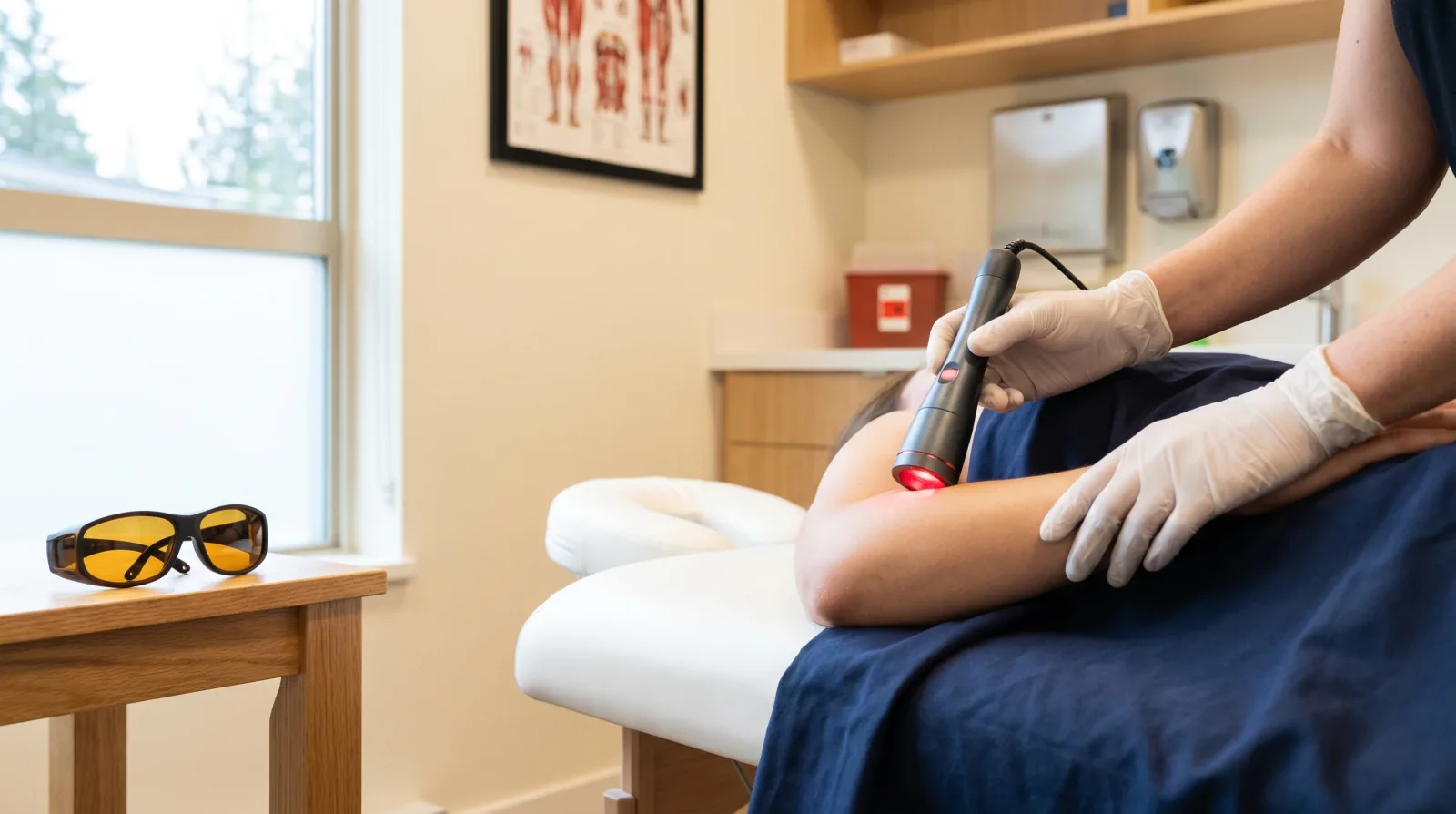
A first session involving laser is part of a regular physiotherapy initial assessment, not a separate treatment booking. The physiotherapist screens for the usual contraindications: known photosensitising medications, suspected malignancy in the treatment field, pregnancy over the abdomen or lower back, active epiphyseal growth plates in paediatric patients, and a few others. If laser is appropriate, we set a dose based on the WALT recommendations for the tissue and depth, then move the handpiece over the affected area for the prescribed time. The patient and the physiotherapist both wear wavelength-specific goggles.
Most laser applications last three to ten minutes per region within a longer session. Patients often feel a gentle warmth. That is expected and is part of the dose response, not a tissue burn. After the laser portion we usually move directly into hands-on work and the exercise plan. The point of the modality is to make the rest of the session more productive, not to replace it.
How long it takes to feel a difference depends on the condition, the tissue, and how acute or chronic the case is. In our clinic we usually reassess after the first block of sessions. We are looking for a measurable change in pain irritability, range of motion, or load tolerance, not just "it feels a bit better." If we are not seeing that change, we adjust the dose, change the modality, or escalate the active rehab. Laser is one tool, not the answer to the question.
When is laser worth trying, and when is it not?
Five clinical situations where we will usually offer it:
- A tendinopathy that is too irritable to load at a meaningful dose yet, where loading still hurts more than it helps.
- A chronic insertional tendon problem (lateral epicondyle, Achilles, plantar fascia) that has plateaued under loading alone.
- A localised soft-tissue injury where the patient needs faster symptom relief to keep working or training.
- Post-surgical soft tissue once the surgeon has cleared the field for therapy.
- An MVA-related soft tissue injury under ICBC where we are trying to keep the active-rehab window open within the first 12 weeks.
Conditions where we will usually tell you laser is not the right tool: radicular low back pain with a clear neurological pattern, suspected red-flag pathology, fracture care outside the surgeon's referral, and most cases where the limiting factor is movement re-education rather than tissue irritability.
A practical note on cost and coverage
Laser therapy at Medstar is delivered inside a physiotherapy session. There is no separate "laser appointment" fee. The session is billed as a physiotherapy visit, which means the standard direct-billing rules apply: extended health, ICBC, WorkSafeBC and MSP supplementary all run through the same billing flow on a physiotherapy line. Current rates and the booking page are on Jane App. If you are unsure whether laser is in scope for your specific funding, message us through the contact page before your first visit and we will check.
The strongest outcomes happen when laser is one part of a session that also includes hands-on assessment and a loading plan you actually follow between visits. The laser does not replace the work. It makes the work tolerable earlier in a flare-up.
For full details on the conditions we treat with high intensity laser therapy and what to expect at your first session, see the service page. Our hub on how HILT compares to shockwave and TECAR goes deeper on the evidence, safety rules, and modality comparisons. If your injury came from a car crash, laser can form part of a treatment plan under ICBC-approved physiotherapy, which is pre-approved for 25 sessions in the first 12 weeks.
This article is general information, not personal medical advice. A regulated practitioner can confirm whether the patterns described apply to you.
Sources
- de Freitas LF, Hamblin MR. Proposed Mechanisms of Photobiomodulation or Low-Level Light Therapy. IEEE Journal of Selected Topics in Quantum Electronics (2016)
- Wang et al. Efficacy of low-level laser therapy in patients with lower extremity tendinopathy or plantar fasciitis: systematic review and meta-analysis of RCTs. BMJ Open (2022)
- Haslerud et al. The Efficacy of Low-Level Laser Therapy for Shoulder Tendinopathy: a systematic review and meta-analysis. Physiotherapy Research International (2015)
- Liu et al. Optimal wavelength of LLLT for knee osteoarthritis: network meta-analysis. Aging Clinical and Experimental Research (2024)
- WALT (World Association for Photobiomodulation Therapy): Dosage recommendations, 904 nm (revised October 2022)
- Health Canada: Guidance for laser products, scope of the regulations
Common questions
Frequently asked questions.
Does high-power laser therapy actually work?
The evidence is strongest for tendinopathy and plantar fasciitis when laser is dosed correctly and combined with active rehab. A 2022 meta-analysis in BMJ Open found significant pain and disability reductions in lower-extremity tendinopathy. Evidence is mixed for knee osteoarthritis and weaker for chronic low back pain.
Is high-intensity laser therapy (HILT) the same as high-power laser therapy?+
Yes. High-intensity laser therapy (HILT) and high-power laser therapy (HPLT) refer to the same type of device: a Class 4 therapeutic laser operating above 500 mW. European research literature tends to use 'HILT'; North American clinics tend to say 'high-power laser' or 'Class 4 laser'. The device, the mechanism (photobiomodulation), and the clinical indications are identical.
What are the clinical indications for high-power laser therapy?+
The strongest evidence supports use for: Achilles tendinopathy, plantar fasciitis, lateral epicondylitis (tennis elbow), shoulder rotator cuff tendinopathy, and patella tendinopathy. Moderate evidence supports use in knee osteoarthritis when pain limits the ability to start active exercise, post-surgical soft tissue repair (surgeon-cleared), and neck pain / whiplash in early ICBC claims. Evidence is weaker for chronic non-specific low back pain and fibromyalgia.
Is Class 4 laser better than cold laser?+
Class 4 delivers more optical power per pulse than cold laser (Class 3B and below), which allows more energy to reach target tissue in the same time. Dose is what matters clinically. A well-dosed Class 3B session and a well-dosed Class 4 session can both be effective. The class number alone is not the deciding factor.
How many laser sessions will I need?+
The number of laser sessions depends on the tissue treated and on how acute or chronic the case is. At Medstar we reassess after every three to four sessions and adjust from there, looking for a measurable change in pain irritability, range of motion, or load tolerance. If that change is not happening, we alter the dose, switch the modality, or push the active rehab harder. We do not pre-sell session packages, because laser is one part of a physiotherapy plan.
Does laser therapy hurt?+
No, high-power laser therapy does not hurt. Most patients feel a gentle warmth over the treated area while the physiotherapist moves the handpiece, which lasts three to ten minutes per region inside a longer session. That warmth is part of the dose response. Sharp pain or a burning sensation is not expected, and you should tell the physiotherapist right away if you feel either. Both you and the practitioner wear wavelength-specific goggles for the whole application.
Is laser therapy covered by ICBC, WorkSafeBC, or extended health?+
Laser therapy is covered wherever physiotherapy is covered, because at Medstar the laser is delivered inside a physiotherapy session and billed on a physiotherapy line. There is no separate laser appointment fee. ICBC, WorkSafeBC, MSP supplementary benefits, and most extended-health plans cover physiotherapy visits that include laser as part of the session, and direct billing runs through the same flow. If you are unsure whether your funding applies, message us through the contact page before your first visit.
When would a physiotherapist say laser is not the right tool?+
Laser is usually not offered for radicular low back pain with a clear neurological pattern, suspected red-flag pathology, fracture care outside a surgeon's referral, or cases where the main problem is movement re-education rather than tissue irritability. In those situations, a loading plan and hands-on assessment do more of the work than a modality can.
Do I need a separate appointment just for laser therapy?+
No. Laser is delivered inside a regular physiotherapy session at Medstar, not as its own appointment or fee. It is paired with hands-on assessment and a loading plan in the same visit, since the laser is meant to make the rehab work tolerable earlier in a flare-up rather than replace it.
Share this post
Copies a ready-to-publish LinkedIn post to your clipboard and opens the LinkedIn share dialog. Paste the text into the composer and publish.
Written by
Amir Ahmadi, PhDDr. Amir Ahmadi is a Registered Physiotherapist, Certified IMS Therapist and former Associate Professor. 20+ years of clinical practice in North Vancouver.
This article is for general information only and does not constitute medical advice, diagnosis, or treatment. Individual presentations vary, and assessment findings and treatment plans differ from person to person. If you are experiencing severe symptoms, neurological changes (numbness, weakness, bowel or bladder changes), or a significant trauma, contact your physician or emergency services. Care at Medstar Sport Physio & Health is provided by practitioners registered with their respective British Columbia regulatory colleges.
Filed under
- laser-therapy
- photobiomodulation
- tendinopathy
- modalities
- north-vancouver
- hilt
- high-intensity-laser