Groin Strains in Hockey and Soccer: Why the Copenhagen Exercise Matters
Groin strains are notorious for coming back. The reason is usually under-loaded adductors, and one exercise has become central to fixing that.
BY AMIR AHMADI, PHD
If you play hockey, soccer, or any sport built on cutting and pivoting, you probably know someone whose groin strain has come back two or three times. It is one of the most frustrating injuries in sport, not because it is hard to heal, but because it is so easy to re-injure. The reason almost always comes down to strength, and there is now a well-supported way to build it.
Groin strains in hockey and soccer players recur at a high rate because many athletes return to sport once pain settles, before the adductors have rebuilt the strength needed for cutting and pivoting. The Copenhagen adduction exercise, a side-plank style movement that loads the inner thigh heavily, has become the most evidence-supported tool for both rehabbing and preventing this injury. It builds the eccentric adductor strength that a hard cut demands. At Medstar Sport Physio in North Vancouver, return-to-sport decisions are based on measurable criteria, including adductor strength symmetry and pain-free cutting, not just on how the groin feels. What the program involves and how long it takes depend on the grade of the strain and the strength deficit at the start of rehab.
What a groin strain actually is
Most groin strains involve the adductors, the group of inner-thigh muscles that pull the leg toward the midline and brake the leg during cutting, pivoting, and rapid changes of direction. In hockey and soccer, these muscles work under high, sudden loads, especially when the leg is planted and the body is changing direction over it. When the demand exceeds what the muscle can tolerate, the tissue strains.
The injury ranges from a mild overload that settles in a couple of weeks to a more significant tear that takes six weeks or longer. The initial healing, though, is rarely where the trouble lies.
Why it keeps coming back
Recurrence is the defining feature of groin strains, and it is mostly a strength problem. Here is the trap. An athlete strains the groin, rests until the pain settles, feels fine walking and jogging in a straight line, and returns to play. The muscle has healed enough to feel normal under low demand, but it has not rebuilt the strength to handle a hard cut. So the first explosive change of direction loads it past its current capacity and it strains again.
This is the same principle we apply to other recurring soft-tissue injuries. As with hamstring strains in soccer and rugby, the recovery is not finished when the pain goes away. It is finished when the muscle can handle the demands of the sport, and that takes deliberate loading.
The Copenhagen adduction exercise
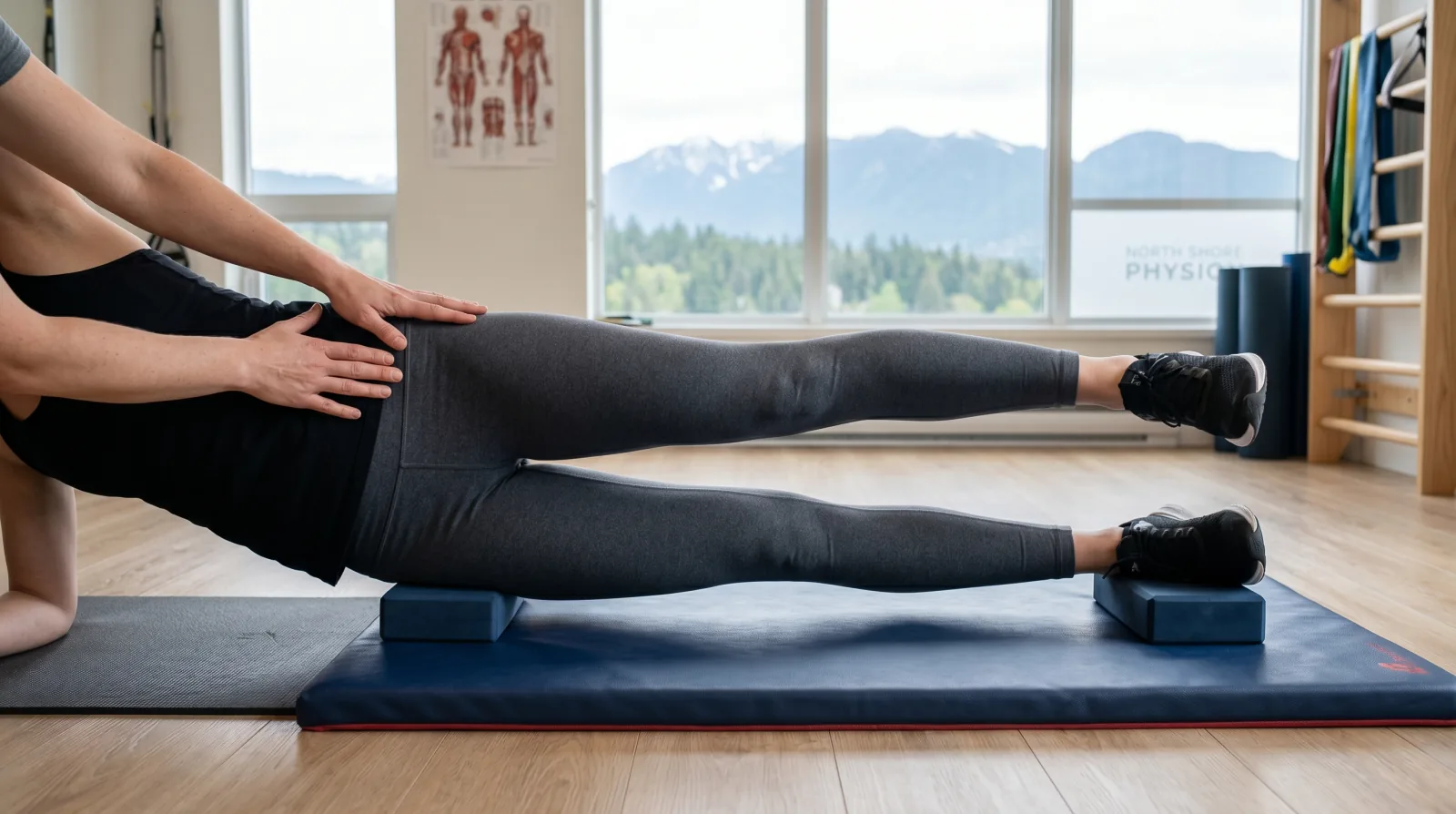
The exercise that has become central to groin rehab and prevention is the Copenhagen adduction. You set up in a side-plank position with your top leg supported on a bench or held by a partner, then lift your body and lower leg using the inner-thigh muscles of the bottom leg. It loads the adductors heavily, particularly in the lengthening phase, which is exactly the demand a hard cut places on them.
The research behind it is genuinely strong. A large study in football players found that a structured adductor-strengthening program built around this exercise meaningfully reduced groin problems across a season. That matters because prevention and treatment use the same mechanism here: build adductor strength and the groin tolerates more.
In practice we start with a regressed version, with the foot or shin closer to the support point so the lever is shorter and the load is manageable, and progress toward the full version as strength returns. The exercise is demanding, and how we scale it depends on how irritable the injury is and how strong the adductors are at the start.
A return-to-sport plan that uses real criteria
The biggest change in how we manage groin strains is moving away from "does it still hurt" toward measurable criteria, the same philosophy we describe in our piece on criteria-based return to sport. For the groin specifically, we look at:
- Adductor strength, measured and compared to the other side and to your own baseline where we have it.
- Pain-free cutting and pivoting at progressively higher speeds.
- Acceleration and deceleration without guarding or compensating.
- Tolerance to sport-specific volume, not just isolated drills.
When those check out, the risk of recurrence drops sharply. When an athlete returns before they do, the groin is being asked to do something it is not yet strong enough for.
Not all groin pain is a strain
It is worth saying clearly that groin pain is not always an adductor strain. The hip joint itself can refer pain into the groin, as can the pubic bones, a hernia, or nerve sources, and sometimes more than one of these overlaps. This is one reason hip problems and groin problems are easy to confuse, and why conditions like hip pain deserve a proper assessment rather than a self-diagnosis.
We screen for these at the first visit. Pain that does not behave like a typical muscle injury, that comes with hip stiffness or clicking, or that does not settle as expected gets investigated rather than loaded blindly.
When to get it assessed
If you have strained your groin and it is your first time, an early assessment shortens the recovery by setting the right starting load and catching anything that is not a simple strain. If you have strained it more than once, that is the clearest sign the strength gap was never closed, and a structured adductor program is overdue.
Book a 30-minute appointment and we will confirm the diagnosis, test your adductor strength, and build a loading plan that gets you back to cutting and pivoting without the injury circling back.
This article is general information about adductor groin strains. It is not personal medical advice. A regulated practitioner can confirm whether the patterns described apply to you.
Sources
- Harøy et al., The Adductor Strengthening Programme prevents groin problems among male football players: a cluster-randomised controlled trial, British Journal of Sports Medicine (2019)
- Serner et al., Return to sport after criteria-based rehabilitation of acute adductor injuries in male athletes, Orthopaedic Journal of Sports Medicine (2020)
- College of Physical Therapists of BC (CPTBC)
Common questions
Frequently asked questions.
How long does a groin strain take to heal?
It depends on the grade. A mild adductor strain may settle enough to return to sport in a couple of weeks, while a more significant one can take six weeks or longer. The bigger issue is not the initial healing but rebuilding adductor strength so it does not recur, which is where most return-to-sport timelines actually get decided.
What is the Copenhagen adduction exercise?+
It is a side-plank style exercise where you support your top leg on a bench or a partner and lift your body using the inner-thigh muscles of the lower leg. It loads the adductors strongly and has become a central exercise in groin-strain rehab and prevention because it builds the eccentric strength the groin needs during cutting and pivoting.
Why do groin strains keep coming back?+
Recurrence is usually about strength, not just healing. Many athletes return to sport once the pain settles but before the adductors have rebuilt the strength to handle cutting, pivoting, and rapid changes of direction. Weak or under-loaded adductors then strain again. A proper program addresses the strength gap, not just the symptoms.
Can I keep playing through a groin strain?+
It is rarely a good idea with a true strain. Pushing through tends to extend the recovery and raise the chance of a more significant tear. We modify load early, rebuild adductor strength, and use objective criteria, like strength testing and pain-free cutting, to decide when it is safe to return rather than guessing from how it feels.
Is groin pain always a muscle strain?+
No. Pain in the groin can come from the hip joint, the pubic bones, a hernia, or referred sources, and in some cases more than one of these overlaps. That is why an assessment matters before assuming it is a simple adductor strain, especially when the pain does not behave like a typical muscle injury or does not settle as expected.
What happens at a first physiotherapy visit for a groin strain?+
The physiotherapist takes a history of how the groin strain happened, tests adductor strength and reproduces the pain with resisted movements to confirm the diagnosis, and screens for the hip, pubic bone, and other sources that can mimic a strain. From there they grade the severity, set an early loading plan, and explain what the return-to-sport criteria will look like as the adductors rebuild strength.
Is a sudden sharp pop in the groin during sport a bigger concern than a gradual ache?+
Yes, it is worth an earlier assessment. A sudden sharp pain or a pop during a cutting or kicking motion can signal a more significant adductor tear rather than a mild strain, and it may take longer to heal. A gradual ache that builds over a session is more often a lower-grade strain, but both patterns benefit from confirming the diagnosis and grade early rather than guessing from how the pain feels.
Can I still walk normally with a groin strain?+
Most people with a mild to moderate adductor strain can still walk, since walking places far less demand on the adductors than cutting, pivoting, or sprinting. Pain with walking, or a limp, suggests a more significant strain or another source of groin pain and is worth having assessed sooner rather than pushing through daily activity.
Share this post
Copies a ready-to-publish LinkedIn post to your clipboard and opens the LinkedIn share dialog. Paste the text into the composer and publish.

Written by
Amir Ahmadi, PhDDr. Amir Ahmadi is a Registered Physiotherapist, Certified IMS Therapist and former Associate Professor. 20+ years of clinical practice in North Vancouver.
This article is for general information only and does not constitute medical advice, diagnosis, or treatment. Individual presentations vary, and assessment findings and treatment plans differ from person to person. If you are experiencing severe symptoms, neurological changes (numbness, weakness, bowel or bladder changes), or a significant trauma, contact your physician or emergency services. Care at Medstar Sport Physio & Health is provided by practitioners registered with their respective British Columbia regulatory colleges.
Filed under
- groin-strain
- adductor
- hockey
- soccer
- north-vancouver