Elbow tendinopathy
Golfer's Elbow | North Vancouver
An ache on the inside of the elbow that bites when you grip, lift, or flex the wrist: a heavy kettlebell, a full grocery bag, a chin-up bar. We load the flexor tendon back to strength rather than waiting it out.
What it is
Understanding your golfer's elbow.
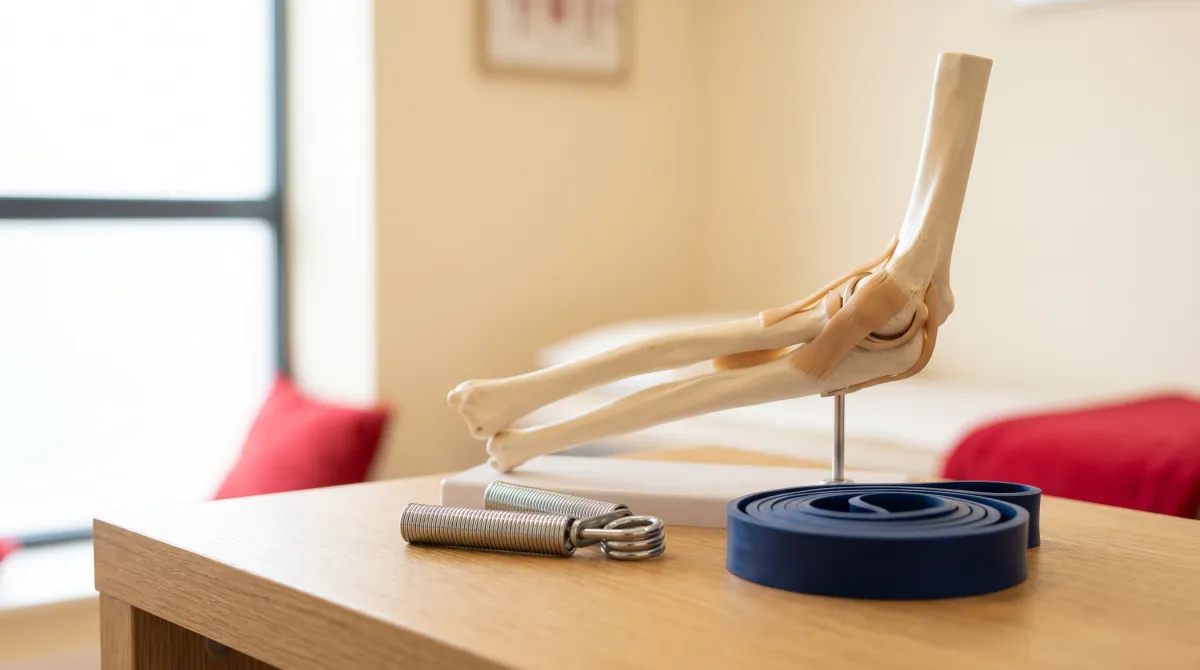
Golfer's elbow, also called medial epicondylitis, is a tendinopathy of the common flexor tendon on the inside of the elbow, the bony bump you can feel on the pinky-side when your palm faces up. That tendon anchors the forearm muscles that bend your wrist and curl your fingers, so it loads up every time you grip, pull, or twist your wrist down. Irritate it enough and the inner elbow aches with the simplest tasks: turning a key, carrying a bag, a firm handshake. At Medstar Sport Physio in North Vancouver, we assess and treat this through a one-on-one physiotherapy appointment, confirming the pattern and building a plan from there. We see patients from across Vancouver and the North Shore, many of whom cross Lions Gate Bridge or take the SeaBus for treatment here.
Despite the name, golf is rarely the culprit. We see it in climbers gripping crimps, trades-people swinging tools, gym-goers ramping up deadlifts and pull-ups, and desk workers whose wrists sit flexed over a keyboard all day. The common thread is repeated gripping or wrist flexion under load, often after a sudden jump in volume that outpaced what the tendon was conditioned for. Poor technique while gripping or lifting adds to the load, and that repeated overuse causes tiny tears in the tendon fibres, which is the source of the pain and inflammation.
The frustrating part is that rest alone doesn't fix it. Backing off settles the irritation for a while, but the tendon stays under-conditioned and lights up the moment you grip hard again. Tendons remodel under the right kind of load, which is why the rehab is built around progressive strengthening rather than simply avoiding the elbow.
What to expect
Many cases of golfer's elbow turn the corner within 6 to 8 weeks of a properly loaded program. Long-standing cases, past the six-month mark, typically take longer and often benefit from adding shockwave. Your physiotherapist sets the next milestone after assessment and adjusts the load as the tendon responds, rather than working to a fixed calendar.
Book a sports assessment with Ali Shafiei
Ali leads sport and orthopaedic physiotherapy at the clinic: manual therapy, IMS dry needling, and exercise-based rehab built around getting you back to your sport, with pain relief along the way. He is taking new patients with same-week availability.
Get a plan
Not sure if we're the right fit?
Send us a quick note about what's going on. A physiotherapist will read it personally and reply with what they'd recommend. No commitment to book.
Common questions
About golfer's elbow.
What's the difference between golfer's elbow and tennis elbow?
Golfer's elbow (medial epicondylitis) affects the flexor tendon on the inside of the elbow, the pinky-side bump when your palm faces up, and flares with gripping and bending the wrist down. Tennis elbow (lateral epicondylitis) hits the extensor tendon on the outside and flares with lifting and bending the wrist up. The rehab principle is the same, loading the tendon back to strength, but which muscles we target and which movements aggravate it differ. See our tennis elbow page for the outer-elbow version.
Should I just rest it until it settles?+
Not on its own. Complete rest calms the irritation briefly but leaves the tendon under-conditioned, so it flares again the first time you grip hard. The better approach is dialling back the volume that aggravates it while progressively loading the tendon in a controlled way. We set the floor and the ceiling for you.
Is a cortisone shot the answer?+
Usually not as a first step. A cortisone injection can quiet the pain for a few weeks, but for elbow tendinopathy it's linked to worse outcomes further down the line. We'd reserve it for a last resort and discuss it with your physician. Loaded rehab, with shockwave added for stubborn cases, is the more durable path.
I lift and climb: do I have to stop completely?+
Rarely completely. The aim is to reduce the specific volume flaring it, easing off heavy pulls or crimpy sessions briefly, while we rebuild the tendon's tolerance, then phase you back to full load. North Shore climbers and gym regulars make up a good share of who we treat for this.
Do you direct-bill extended health?+
Yes. We direct bill most major extended-health insurers, plus ICBC and WorkSafeBC, and we handle the paperwork. Golfer's elbow often comes from repeated gripping or wrist flexion under load, whether that's climbers gripping crimps, trades-people swinging tools, or a sudden jump in gym volume, so a workplace or ICBC claim is common alongside extended-health coverage. We coordinate directly with whichever insurer applies to your case.
Who typically gets golfer's elbow?+
Despite the name, golf is rarely the cause of golfer's elbow. We see it most in climbers gripping crimps, trades-people swinging tools, gym-goers ramping up deadlifts and pull-ups, and desk workers whose wrists sit flexed over a keyboard all day. The common thread is repeated gripping or wrist flexion under load, often after a sudden jump in volume the tendon wasn't ready for.
Could my shoulder be contributing to my golfer's elbow?+
It's worth checking. As part of golfer's elbow treatment, we look up the chain at shoulder and scapular strength, because a weak link there can quietly dump extra load into the forearm and inner elbow. Addressing that alongside direct tendon loading helps prevent the pattern from coming back once the elbow settles.
Is there anything I can wear to ease the pain day to day?+
A counterforce brace or strap can be used as a short-term measure to offload the tendon during aggravating tasks, alongside ice or heat to ease inflammation and discomfort while the golfer's elbow is most reactive. It's a support alongside loaded rehab, not a substitute for it.
Reviewed by Amir Ahmadi, PhD, MSc PT, Registered Physiotherapist, Certified IMS Therapist, College of Physical Therapists of British Columbia (CPTBC). Last reviewed July 2026.
This page is for general information only and does not constitute medical advice, diagnosis, or treatment. Individual presentations vary, and assessment findings and treatment plans differ from person to person. If you are experiencing severe symptoms, neurological changes (numbness, weakness, bowel or bladder changes), or a significant trauma, contact your physician or emergency services. Physiotherapy at Medstar Sport Physio & Health is provided by physiotherapists registered with the College of Physical Therapists of British Columbia (CPTBC).
Related reading
- Tennis elbow: the outer-elbow (lateral) version with the same tendon-loading principle →
- IMS dry needling: release the forearm flexor trigger points that hold inner-elbow pain in place →
- Shockwave therapy: for chronic medial epicondylalgia that hasn't responded to loading →
- Sport physiotherapy: the manual therapy and tendon-loading plan that resolves the case →
- Golfer's elbow: the inner-elbow tendinopathy that loading fixes →