
TMJ & jaw
TMJ Disorders & Jaw Pain | North Vancouver
Clicking, locking, headaches that start at the temple, a jaw that won't open wide enough to bite into a sandwich. We treat the joint, the muscles, and the neck that's usually feeding it.
What it is
Understanding your tmj disorder / jaw pain.
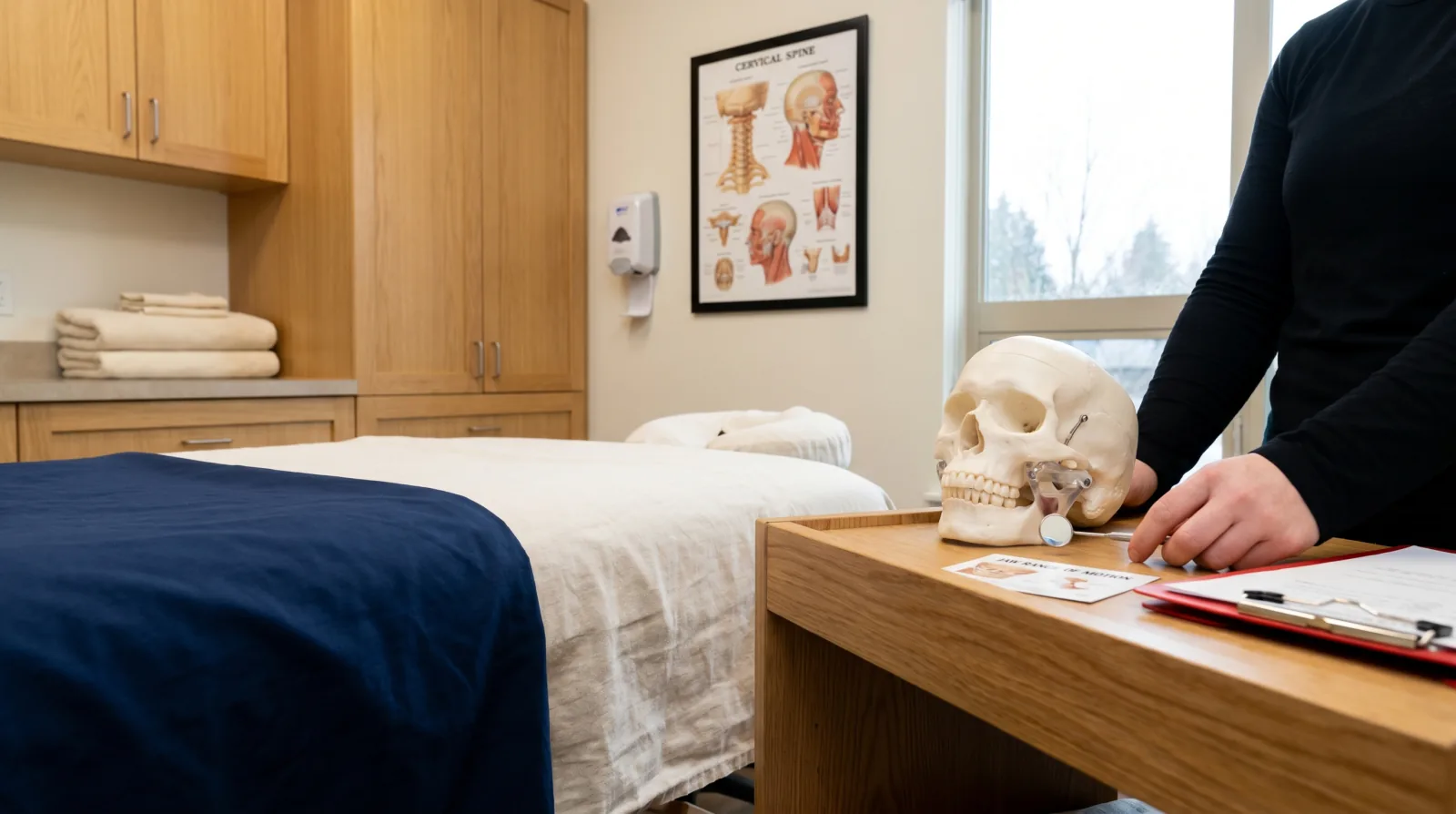
The temporomandibular joint (TMJ) is the hinge in front of each ear that lets you chew, talk, and yawn. A TMJ disorder is any combination of pain, clicking, locking, or restricted movement at that joint. It often comes packaged with headaches at the temple, ear-area pressure that doesn't behave like an ear infection, and a feeling of tightness running from the jaw down into the neck. At Medstar Sport Physio in North Vancouver, we assess and treat this through a one-on-one physiotherapy appointment, confirming the pattern and building a plan from there. We see patients from across Vancouver and the North Shore, many of whom cross Lions Gate Bridge or take the SeaBus for treatment here.
Most TMJ cases we see aren't really a 'joint' problem in isolation. They are a joint, the muscles that control it (masseter, temporalis, the lateral and medial pterygoids), and the upper cervical spine all winding each other up. Night clenching or grinding, a forward head posture from a long day at the screen, a recent dental procedure, or stress that lives in the jaw: any of those can tip the system over. So can a direct blow or whiplash to the jaw, a bite that doesn't line up (malocclusion), and arthritic or degenerative change in the joint itself, which adds stiffness and inflammation on top of everything else.
What this means in practice is that treating only the joint, or only the bite, often leaves a third of the problem in place. The first assessment is about figuring out which of those drivers is doing the most work for your case.
What to expect
Many TMJ cases improve noticeably in the first 3 to 5 sessions once joint and muscle work are paired together. Cases involving long-standing night clenching or recent dental work can take longer. Your physiotherapist will set the next milestone after assessment.
Get a plan
Not sure if we're the right fit?
Send us a quick note about what's going on. A physiotherapist will read it personally and reply with what they'd recommend. No commitment to book.
Common questions
About tmj disorder / jaw pain.
Do you do intra-oral TMJ work?
Yes, when it's indicated and you've consented to it, using gentle techniques applied with a glove. The physiotherapist will explain what it involves, why it's being recommended, and what to expect before starting. External-only manual mobilization also works well for many TMJ presentations, so intra-oral work is never a default for every case.
Should I see a dentist first?+
Not necessarily. A dental review is helpful if there's a clear bite issue, recent dental work, or significant clenching that warrants a night guard. We're happy to coordinate with your dentist when that's the right call. For most jaw-and-neck-driven cases, physio is a reasonable first step.
Will the clicking go away?+
Sometimes. A click without pain is generally not a problem on its own. A click that comes with pain, locking, or restricted opening is what we treat. Reduction in pain and improvement in opening tend to come first; the click itself may or may not fully resolve.
Is jaw pain the reason for my headaches?+
It can be a major contributor. TMJ-driven and cervicogenic headaches often live together: clenching loads the temporalis, the upper neck stays stiff, and pain refers up into the temple as head pressure that doesn't behave like a typical headache. Treating the jaw and the upper cervical spine together, rather than the head in isolation, is usually what moves the pattern.
Do you direct-bill extended health?+
Yes. Direct billing for most major extended-health insurers, plus ICBC and WorkSafeBC. That matters for jaw pain too, since a direct blow or whiplash from a crash can tip the TMJ system over just as easily as night clenching or a stressful stretch at the screen, so a portion of what we treat here starts as an ICBC claim.
What actually causes TMJ disorders?+
TMJ disorders usually come from several things loading the joint at once rather than one single cause. Night clenching or grinding, forward head posture from long screen time, a recent dental procedure, stress held in the jaw, a direct blow or whiplash to the jaw, a bite that doesn't line up, and arthritic change in the joint itself can all tip the system over. The first assessment figures out which of those is doing the most work in your case.
How long until my TMJ symptoms improve?+
Many TMJ cases improve noticeably in the first 3 to 5 sessions once joint and muscle work are paired together. Cases involving long-standing night clenching or recent dental work can take longer to settle. Your physiotherapist sets the next milestone once they've assessed how the joint, muscles, and neck are contributing to your symptoms.
What can I do at home to help my jaw?+
Softer-food choices, mindful chewing patterns, and a sleeping position that doesn't load the jaw all help during a flare, alongside postural and ergonomic adjustments for screen time and jaw-resting positions through the day. Relaxation and breathing techniques can ease the night clenching and grinding that load the joint, so the gains from treatment hold between sessions instead of being undone by daily habits.

Reviewed by Amir Ahmadi, PhD, MSc PT, Registered Physiotherapist, Certified IMS Therapist, College of Physical Therapists of British Columbia (CPTBC). Last reviewed July 2026.
This page is for general information only and does not constitute medical advice, diagnosis, or treatment. Individual presentations vary, and assessment findings and treatment plans differ from person to person. If you are experiencing severe symptoms, neurological changes (numbness, weakness, bowel or bladder changes), or a significant trauma, contact your physician or emergency services. Physiotherapy at Medstar Sport Physio & Health is provided by physiotherapists registered with the College of Physical Therapists of British Columbia (CPTBC).
Related reading
- Jaw and TMJ pain after a car crash: ICBC-covered rehab →
- Headaches: cervicogenic and tension headaches often overlap with TMJ →
- Neck pain: neck dysfunction frequently accompanies jaw problems →
- IMS dry needling for jaw and cervical muscle tension →
- TMJ physiotherapy and jaw pain: journal article →
- Tension headache or neck headache? Why the difference changes the treatment →