Running Gait Analysis for North Shore Trail Runners: What It Catches and What It Misses
A gait analysis is most useful for the runner who keeps getting injured in the same spot. Here is what a clinical analysis at Medstar looks for, what the evidence supports changing, and the trail-specific patterns we see most on the North Shore.
BY MEDSTAR SPORT PHYSIO TEAM
Quick answer. A clinical running gait analysis is a structured 60-minute session combining functional screening, treadmill video capture from multiple angles, kinematic measurement of key joint positions, and a written summary linking the pattern to the patient's symptom history. It is most useful for runners with a recurring injury in the same region. It is not a universal optimisation tool, and the evidence does not support most "natural form" coaching as injury-preventive for asymptomatic runners. We use it at Medstar to guide targeted intervention — typically strength work, cadence adjustment, footwear discussion, and mileage progression — not to retrain runners who are running well.
If you are a North Shore runner — Capilano dam loops, Lower Seymour Conservation Reserve, the BCMC, the Grouse Grind in late spring, the Knee Knacker — and you have been dealing with a recurring symptom that keeps showing up at the same mileage threshold, this is the conversation we have when you book in.
What a clinical gait analysis actually examines
A clinical running gait analysis is not the same as a retail shoe-store treadmill clip. We look at the movement pattern in several layers.
Static and functional screening. Before any running, we screen lower-limb strength (single-leg calf raises, single-leg squat depth, hip abduction endurance), joint mobility at the hip, knee, and ankle, and a quick functional movement screen. The screening produces a list of strength and mobility findings that will be cross-referenced against the running pattern.
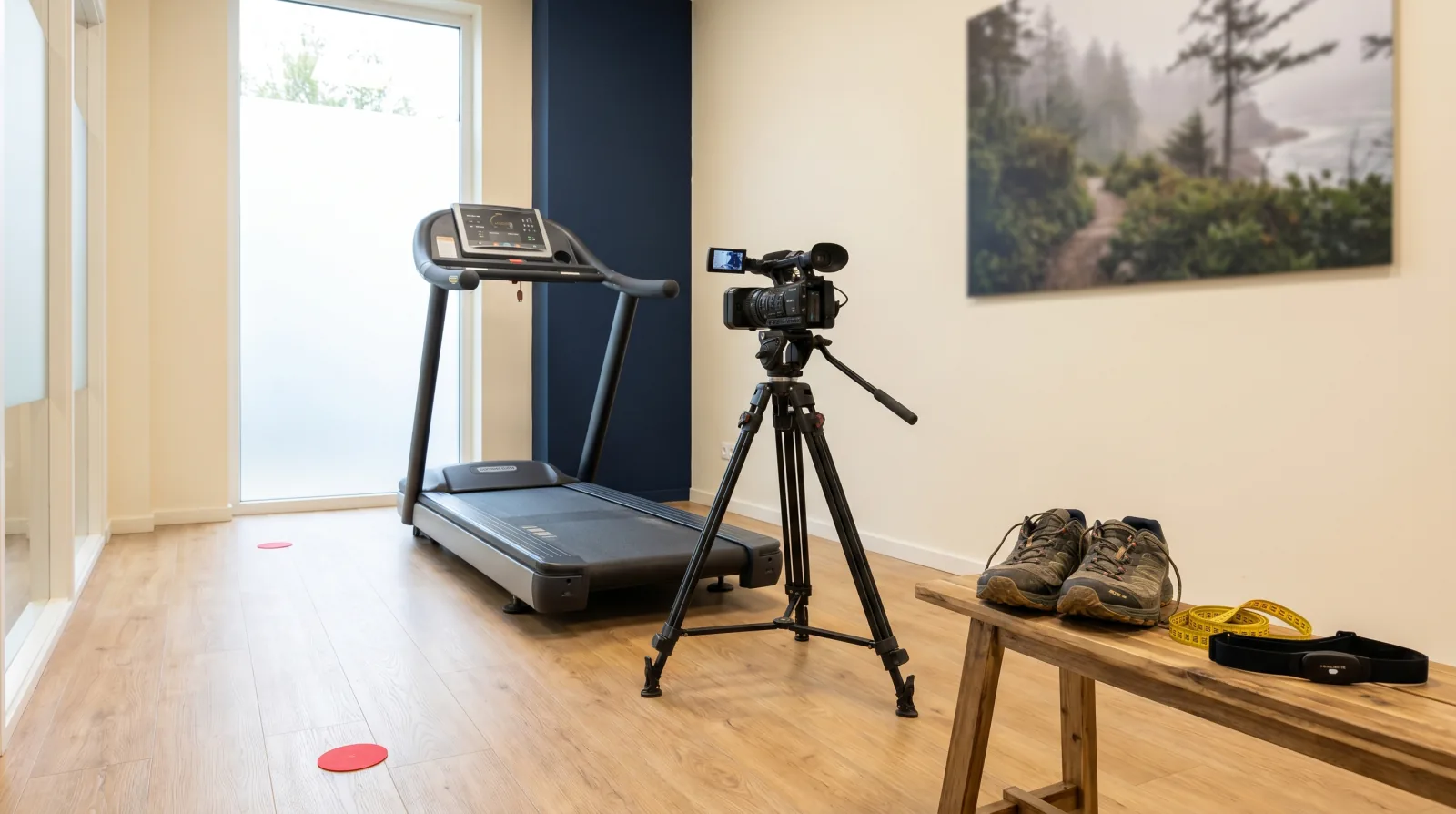
Treadmill warmup at the patient's typical training pace. We let the patient settle into their normal rhythm — a treadmill is a different surface than the trail, and the first 90 seconds are usually unrepresentative. We capture two to three minutes of steady running at training pace.
Video capture from three angles. Sagittal (side), posterior (back), and anterior (front) at high frame rate. We slow the video for analysis at four key gait events: initial contact, mid-stance, terminal stance, and mid-swing.
Key kinematic measurements. We focus on a short list of variables that have evidence behind them in the British Journal of Sports Medicine consensus on running gait retraining:
- Vertical oscillation and step cadence.
- Hip drop in stance phase (contralateral pelvic drop).
- Knee valgus collapse on weight acceptance.
- Foot strike pattern and overstride pattern.
- Trunk lean.
Symptom correlation. Every finding is cross-referenced against the patient's symptom history. A contralateral pelvic drop on the symptomatic side that lines up with iliotibial band irritation, a high vertical oscillation pattern in a runner with chronic anterior shin pain, an overstride pattern in a runner with recurrent hamstring grumbles — these are the cases where the analysis adds clear clinical value.
What the evidence supports changing
The literature on running gait retraining is real but narrower than the popular conversation suggests. The interventions with the most supporting evidence:
- Cadence increase. A 5 to 10% increase in cadence reduces ground reaction forces, peak knee flexion moment, and step length in symptomatic runners. The Heiderscheit et al. study on step rate manipulation in the Journal of Orthopaedic and Sports Physical Therapy is the foundational reference. Useful for patellofemoral pain and some shin pain presentations.
- Reducing overstride. Cueing the foot to land closer to the body's centre of mass tends to reduce braking forces and is associated with lower injury rates in some prospective studies. Cadence increases often accomplish this naturally.
- Hip abduction strength. Strengthening the gluteus medius and the hip external rotators reduces contralateral pelvic drop and is associated with improved outcomes in patellofemoral pain — see the JOSPT clinical practice guideline on patellofemoral pain.
The interventions with weak or contradictory evidence:
- Heel-to-forefoot strike conversion in asymptomatic runners. Forefoot striking shifts load from the knee to the calf and Achilles; whether that is preventive depends entirely on which tissue is the problem. Forcing a strike change in an asymptomatic runner can create a new injury.
- "Natural" running prescriptions. No single gait pattern is universally healthier. The pattern that is right for a given runner depends on their anatomy, strength, history, and the surface they run on.
Trail-specific patterns we see on the North Shore
North Shore trail running adds variables that road running does not. Three patterns we see in season:
Downhill control deficits. The descents from Mount Fromme, BCMC, or any of the Seymour singletrack put the quadriceps and gluteus medius under heavy eccentric load. Runners who have not built downhill-specific strength tend to over-rely on hip drop and trunk lean to absorb the descent. The symptom shows up at the front of the knee or in the ITB on the lateral hip. The intervention is more eccentric strength work, not a stride change.
Cadence variability on technical footing. Even runners with a clean treadmill cadence often shorten and overstride on technical trail because the eye is on the next foot placement, not the rhythm. Cadence work is harder to teach for trail runners than for road runners. We coach pacing strategies rather than absolute cadence.
Heel-strike runners on the steep climbs. A heel strike on a steep climb is mechanically inefficient and shifts load forward in the chain. The fix is usually a slightly shorter stride on the climb rather than a strike conversion.
Calf and Achilles patterns in trail runners. Trail running tends to load the calf and Achilles more than road running because of the descent eccentric demand and the variable foot placement. Trail runners with chronic Achilles symptoms often show a calf strength deficit on the symptomatic side. Heavy slow-resistance calf loading is usually the highest-yield intervention.
What the analysis does not catch
Two things to be honest about.
A treadmill is not a trail. Anyone who has run a North Shore singletrack knows the gait changes constantly with the terrain. The treadmill analysis is a controlled measurement at a controlled pace — it does not capture descent mechanics, technical footing, or the cumulative pattern over a long run. We use the treadmill pattern as a reference, not as the whole picture.
Gait analysis cannot diagnose tissue pathology. A finding on video correlates with risk and with symptom; it does not confirm what is happening in the tendon or the bone. If symptoms are not responding to the intervention, that is the time to escalate to imaging via the family physician, not to chase finer gait corrections.
How we use the analysis in the rehab plan
A typical post-analysis plan in our clinic looks like this:
- A short list of two or three intervention priorities, ranked.
- A strength program targeting the screening findings — typically progressed twice a week over six to eight weeks.
- A cadence or stride cue if the analysis supports it, practised in a controlled context (treadmill or short out-and-back) before being layered into normal training.
- A mileage and intensity plan that respects the typical North Shore season — many of our trail-running patients are training for the Knee Knacker, the Iron Knee, the Squamish 50, or shorter local series — and that builds load gradually rather than in surges.
A gait analysis is one input into a runner's plan, not the plan itself. The runners who get the most from it are the ones who keep coming back for a follow-up at week six and adjust the plan based on how the body has responded.
This article is general information about clinical running gait analysis. It is not personal medical advice. A regulated practitioner can confirm whether the patterns described apply to you.
Sources
- Barton et al. — Running retraining to treat lower limb injuries, BJSM
- Heiderscheit et al. — Effects of step rate manipulation on joint mechanics during running, JOSPT
- JOSPT — Patellofemoral pain clinical practice guidelines
- College of Physical Therapists of BC (CPTBC)
Written by
Medstar Sport Physio Team
Registered clinician at Medstar Sport Physio & Health, North Vancouver.
Filed under
- running
- gait-analysis
- trail-running
- north-vancouver
- injury-prevention